
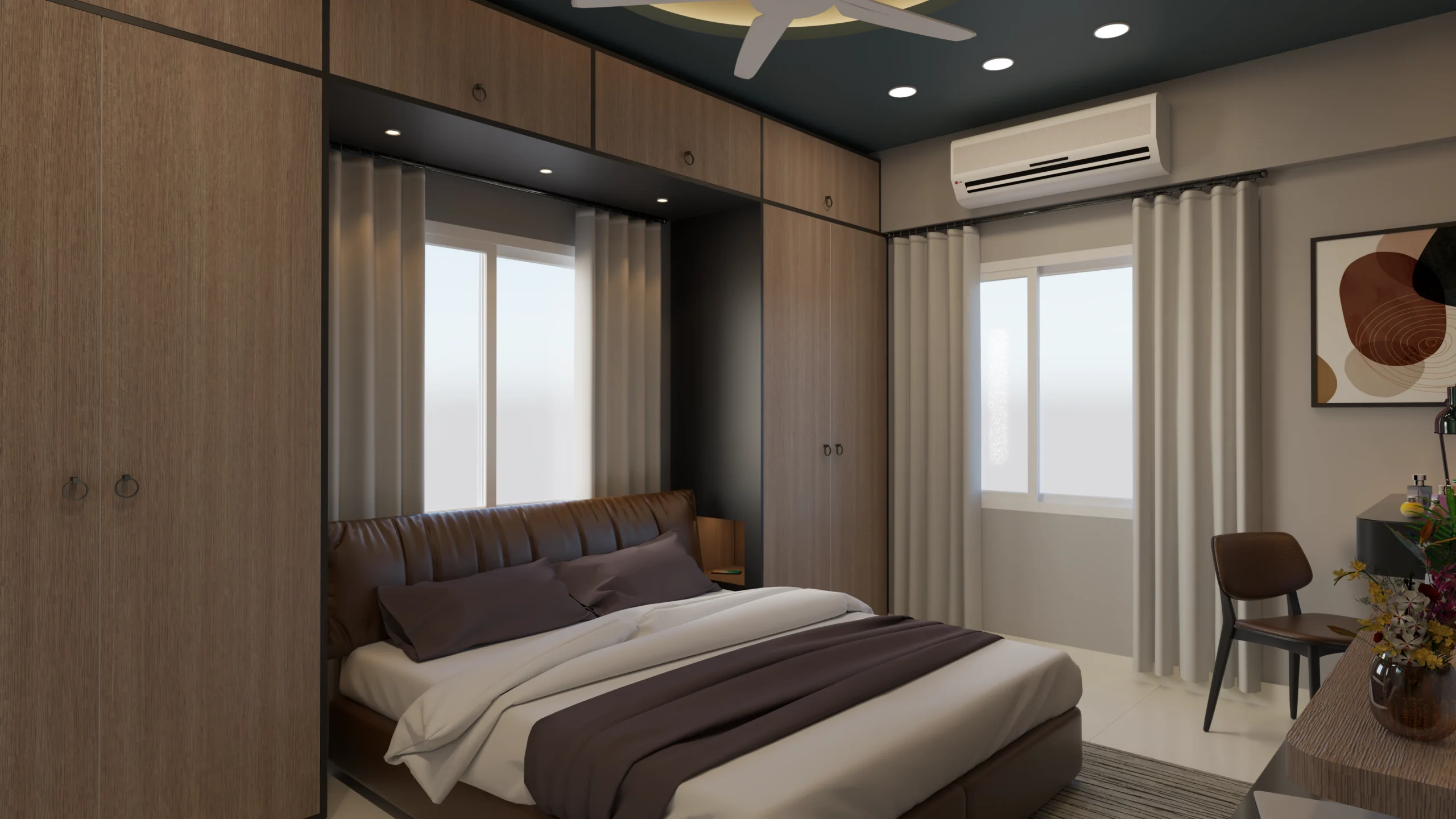
I am writing this from a quiet corner of a gallery in Mayfair, where a single Giacometti sculpture occupies the centre of an otherwise empty room. There is no clutter, no competing narrative, no visual noise. There is only intention. And it is in this precise moment of spatial clarity that I find myself returning, as I so often do, to the question that has quietly governed my entire career: what is the true purpose of modern interiors? Not merely what they look like, but what they do, what they communicate, and what they ask of the people who inhabit them. The purpose of modern interiors, I would argue, extends far beyond the surface. It reaches into the psychological, the cultural, and the deeply personal. It is a discipline that demands we ask harder questions before we ever select a single material or commission a single piece.
The world of design has, in recent decades, become increasingly seduced by the visual. Social media has accelerated this tendency, reducing complex spatial narratives to a single curated image, a flat representation of something that was always meant to be experienced in three dimensions, in real light, with real texture beneath one’s fingertips. And yet, the most enduring interiors I have encountered across my years of practice, from the quiet grandeur of a Kyoto ryokan to the restrained opulence of a Parisian hôtel particulier, have never been primarily about appearance. They have been about experience. They have been about the way a room makes you breathe differently the moment you cross its threshold.
Material Intelligence and the Language of Permanence
Why Raw Materials Carry Moral Weight
I have always believed that the materials we choose for a space are, in essence, a declaration of values. Aged leather, with its patina of use and time, speaks of permanence, of an investment in quality that transcends the seasonal. Honed marble, cool and faintly veined, carries within it the geological memory of millennia; it is, quite literally, time made tangible. These are not merely aesthetic choices. They are philosophical ones. When a client chooses a material that will age beautifully rather than one that will simply look new for a season, they are making a statement about how they intend to inhabit the world: with patience, with discernment, with a preference for depth over novelty. This is the material intelligence that defines truly purposeful interiors, and it is something I champion without reservation at The Shape Interiors.
The proliferation of what I privately refer to as “fast furniture” has done considerable damage to our collective understanding of what a room can be. When every surface is replaceable, when every piece is chosen for its immediate visual impact rather than its long-term contribution to a spatial narrative, the room loses its capacity to accumulate meaning. It becomes, in effect, a backdrop rather than a protagonist. The rooms that I find most compelling, most genuinely alive, are those in which every element has been chosen with the understanding that it will be lived with, not merely looked at. A hand-thrown ceramic vessel on a shelf. A length of aged linen at a window. A floor of reclaimed stone that carries the faint impressions of previous lives. These are the details that transform a room from a collection of objects into a genuine environment.
Texture, Scent, and the Sensory Architecture of a Space
We speak endlessly about the visual qualities of an interior, and yet the most powerful spatial experiences are rarely primarily visual. They are multisensory. The particular quality of afternoon light as it moves across a plaster wall, warm and slightly amber, shifting almost imperceptibly as the hours pass. The faint scent of beeswax polish on aged oak floorboards. The subtle resistance of a heavy linen curtain as it falls back into place. These are the sensory details that lodge themselves in memory, that make a room feel not merely beautiful but genuinely inhabited. Designing with sensory intelligence means considering not only what a space looks like, but what it sounds like, what it smells like, what it feels like beneath the hand. It is a more demanding form of practice, but it is also a far more rewarding one.
Spatial Storytelling and the Edit as a Design Principle
The Discipline of Restraint
One of the most misunderstood principles in contemporary interior design is restraint. It is frequently confused with minimalism, which is itself a specific aesthetic language with its own rules and references. Restraint, by contrast, is not an aesthetic; it is a discipline. It is the capacity to recognise when a room has reached its point of equilibrium and to resist the impulse to add more. It is the understanding that empty space is not wasted space; it is breathing room, the visual silence that allows the elements that are present to be fully perceived and appreciated. The edit, as I think of it, is perhaps the single most powerful tool available to a designer. To know what to remove is a far greater skill than knowing what to add.
This principle applies with particular force to the interiors of those who have accumulated, over a lifetime, a significant collection of objects, art, and furniture. The challenge in such spaces is not one of addition but of curation: of understanding which pieces carry sufficient weight to earn their place in the room, and which, however beloved, are diminishing the overall spatial narrative by their presence. This is a conversation that requires both sensitivity and honesty, and it is one that I find among the most intellectually engaging aspects of my practice. A room that has been properly edited feels, paradoxically, more generous than one that is full. It offers the eye a place to rest, the mind a moment of stillness.
Narrative Continuity Across a Home
A home, at its most considered, is not a collection of individual rooms but a single, continuous spatial narrative. The materials, the palette, the quality of light, the scale of furniture: all of these elements should speak to one another across thresholds, creating a sense of coherence that is felt rather than consciously observed. This does not mean uniformity. A home that is too consistent becomes monotonous, a single note sustained without variation. What it means, rather, is that each room should feel like a chapter in the same story, distinct in its mood and purpose but recognisably part of the same authorial voice. Achieving this kind of narrative continuity requires a clarity of vision that must be established at the very beginning of a project and maintained, with discipline, throughout every subsequent decision.
The Emotional Architecture of Purposeful Living
How Rooms Shape Behaviour and Thought
The relationship between environment and behaviour is one of the most compelling areas of contemporary research in environmental psychology, and it is one that has profound implications for the practice of interior design. We know, with considerable certainty, that the spaces we inhabit shape the way we think, feel, and behave. A room flooded with natural light encourages optimism and energy. A space of carefully controlled acoustic quality supports concentration and creative thought. A bedroom stripped of visual complexity and designed around the specific requirements of restorative sleep genuinely improves the quality of that sleep. These are not abstract propositions; they are practical, evidence-based realities that should inform every design decision we make. The purpose of modern interiors is, in this sense, nothing less than the active support of human flourishing.
The Elena Edit: Design Dictates for Purposeful Interiors
- Begin with intention: Before selecting a single material or piece of furniture, define the emotional purpose of the room. What should it make its inhabitant feel?
- Invest in permanence: Choose materials that age with dignity. Marble, aged leather, solid timber, and hand-finished plaster will outlast any trend and accumulate beauty with time.
- Edit with rigour: Remove anything that does not earn its place. A room of ten considered objects will always outperform a room of fifty indiscriminate ones.
- Design for all the senses: Consider texture, acoustic quality, scent, and the quality of light at different times of day. A room experienced only visually is a room only half designed.
- Honour narrative continuity: Ensure that the materials, palette, and spatial language of each room speak coherently to the rest of the home. Coherence is not uniformity; it is authorial consistency.
- Respect the architecture: Work with the inherent qualities of the space rather than against them. A room with beautiful bones requires only the confidence to let them show.
- Commission with discernment: Seek out craftspeople and makers whose work carries genuine skill and heritage. The provenance of an object contributes to the meaning of the room it inhabits.
There is a particular kind of quiet that settles over a room that has been designed with genuine purpose. It is not the quiet of emptiness, nor the quiet of neglect. It is the quiet of a space that knows exactly what it is and what it is for. I have felt it in a library in Edinburgh, where the smell of old paper and the particular amber of afternoon light through leaded glass created an atmosphere so complete that conversation felt almost unnecessary. I have felt it in a dining room in Milan, where the weight of the table, the depth of the candlelight, and the faint warmth of aged terracotta underfoot conspired to make every meal feel like a ceremony. These rooms were not merely beautiful. They were purposeful. And it is that quality, above all others, that I believe we must pursue in the practice of modern interior design.
Perhaps the most honest question we can ask of any room is not “does it look beautiful?” but “does it make life better?” Does it support the particular rhythms and rituals of the person who inhabits it? Does it offer them something they could not find elsewhere: a quality of light, a sense of enclosure, a material warmth that makes the ordinary act of being at home feel, in some small but significant way, like a privilege? If the answer is yes, then the room has achieved something far more valuable than beauty. It has achieved purpose. And purpose, I have come to believe, is the highest ambition of the interior designer’s art. I would be genuinely interested to know: when you consider the spaces you inhabit, which rooms have shaped you most profoundly, and what was it, precisely, that gave them that power? I invite you to share your reflections in the comments below.
The architecture of your legacy is defined not merely by the objects you choose, but by the standard of life you refuse to compromise on. At The Shape Interiors, we specialise in the silent language of luxury, transforming raw space into sophisticated environments that resonate with the human spirit and professional excellence. Whether you are defining a private sanctuary or a global corporate headquarters, the requirement remains the same: a vision executed with absolute precision.
We invite you to explore our work and discover why the world’s most discerning individuals trust us with their most personal and professional environments.
Refine Your World.
Your journey toward an unparalleled environment begins with a single conversation. Connect with our global design team to initiate your bespoke project.