
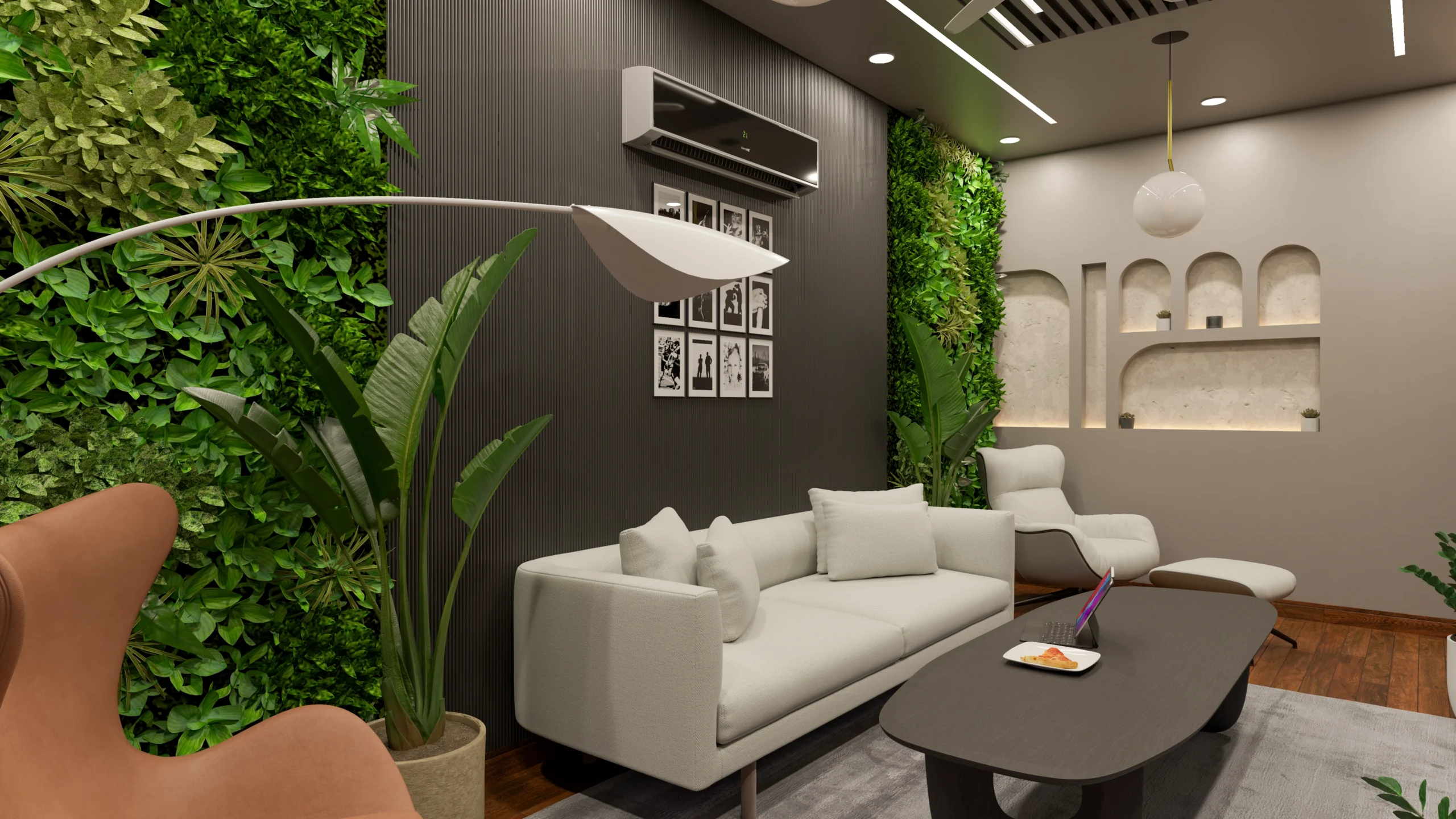
I am writing this from a quiet corner of a gallery in Mayfair, where a single Giacometti sculpture occupies the centre of an otherwise bare room. There is no clutter, no competition, no noise. There is only the figure, the light falling at a precise angle from a north-facing skylight, and the deliberate emptiness that surrounds it like a held breath. It is, without question, one of the most beautifully composed spaces I have encountered this season, and it has nothing to do with furniture, fabric, or finish. It has everything to do with visual rhythm in open spaces, and the profound intelligence of knowing precisely where to place nothing at all. This is the principle I wish to explore with you today, because it is, I believe, one of the most misunderstood and undervalued disciplines in the entire canon of high-end interior design.
Visual rhythm in open spaces is not a decorative afterthought. It is the architectural grammar that determines whether a room feels like a composition or a collection, a sanctuary or a showroom. Much like the intervals between notes in a musical score, the spaces between objects, the pauses between planes of colour, and the measured distances between light sources are what give a room its emotional cadence. When these intervals are calibrated with precision and intention, the result is a space that breathes, that moves, that speaks to the inhabitant in a language they may not consciously understand but will absolutely, viscerally feel.
The Architecture of Pause: Understanding Visual Rhythm in Open Spaces
The Interval as a Design Element
In music theory, the interval is the distance between two notes. It is not the notes themselves that create melody; it is the relationship between them, the tension and resolution, the anticipation and arrival. Interior design operates on an identical principle, though we rarely articulate it with such precision. The interval in a room is the negative space between a console and a chair, the gap between a pendant light and the ceiling plane above it, the deliberate void left on a wall where a lesser designer might have hung another piece of art. These intervals are not absences; they are active, breathing elements of the composition. To treat them as such is to elevate one’s practice from decoration to architecture.
I have walked through countless properties across London, Milan, and Tokyo where the instinct to fill every surface has resulted in spaces that feel, despite their obvious expense, profoundly exhausting. The eye has nowhere to rest. The mind has no moment of resolution. Every object, however beautiful in isolation, is cancelled out by its neighbour, and the cumulative effect is one of visual noise rather than visual music. The antidote is not minimalism for its own sake; it is the disciplined, considered deployment of the interval as a structural tool.
Rhythm Versus Repetition
There is a critical distinction to be made between rhythm and repetition, and it is one that separates the truly sophisticated interior from the merely coordinated one. Repetition is the mechanical recurrence of identical elements: three identical cushions, four matching chairs, a row of identical pendants spaced at equal intervals. It is orderly, certainly, but it is also inert. Rhythm, by contrast, implies variation within a framework, a syncopation, a counterpoint. It is the grouping of three objects of differing heights on a single surface, each related by material or tone but differentiated by scale. It is the way a low-slung sofa creates a visual rest before the eye travels upward to a tall, narrow artwork. Rhythm implies movement through a space, a choreography of the gaze that the designer orchestrates with the same intentionality as a conductor leading an orchestra through a complex passage.
Material Intelligence and the Language of Texture
The Sensory Conversation Between Surfaces
Visual rhythm in open spaces is inseparable from material intelligence, because it is the interplay of textures, finishes, and tactile qualities that gives rhythm its depth and resonance. Consider the relationship between a slab of honed Calacatta marble and the aged, hand-stitched leather of a reading chair placed nearby. These two materials are in conversation: one cool, geological, ancient in its formation; the other warm, organic, bearing the quiet evidence of time and use. The interval between them, whether physical or visual, is charged with meaning. The eye moves between them not randomly but purposefully, drawn by contrast and resolved by the underlying harmony of their shared palette.
This is the kind of material intelligence that cannot be purchased from a catalogue or replicated by a fast-furniture solution. It requires an understanding of how surfaces behave in different qualities of light, how the grain of a stone responds to the warmth of an afternoon sun, how the patina of aged brass deepens in the shadow of a recessed shelf. At The Shape Interiors, this conversation between materials is the foundation upon which every spatial composition is built, because we understand that a room is not a static image but a living, shifting experience that changes with the hour, the season, and the quality of the light.
The Weight of Raw Materials in a Composed Space
There is a gravitational quality to raw, honest materials that synthetic alternatives simply cannot replicate. A room anchored by a slab of travertine, a length of unlined linen, or a piece of hand-thrown ceramic possesses a kind of quiet authority that immediately communicates permanence and considered taste. These materials carry history within their very structure: the compressed millennia of a limestone floor, the slow craft of a hand-knotted rug, the singular imperfection of a blown-glass vessel. When deployed with rhythmic intelligence, they do not merely furnish a space; they narrate it. They tell the story of a life lived with discernment, of choices made slowly and with great care, of an aesthetic sensibility that values the enduring over the expedient.
Light as the Conductor of Spatial Rhythm
Orchestrating Natural and Artificial Light
If material is the vocabulary of a room, then light is its syntax, and no discussion of visual rhythm in open spaces can proceed without a serious examination of how light moves, pools, and recedes across a composition. Natural light is, of course, the supreme luxury, and the orientation of a space relative to the sun’s arc is one of the first considerations in any serious design project. A north-facing room receives a cool, consistent, diffused light that is extraordinary for art and for the appreciation of subtle material variation. A south-facing space is flooded with warmth and drama, its shadows long and theatrical in the morning and evening hours. The designer’s role is to understand this choreography and to work with it rather than against it, positioning reflective surfaces to amplify, and matte surfaces to absorb, in a carefully considered dialogue with the natural world.
Artificial light, when approached with the same rigour, becomes an instrument of extraordinary precision. The layering of ambient, task, and accent lighting creates a rhythm of its own: the broad wash of a recessed ceiling fixture establishing the ground note, the focused beam of a picture light drawing the eye to a specific point of interest, the warm glow of a table lamp creating an intimate pool of warmth within a larger, cooler space. Each layer operates at a different register, and together they produce a composition of light that is as carefully scored as any piece of music.
Shadow as a Design Tool
We speak endlessly about light in design, and yet shadow is its equal partner, its necessary counterpoint. A room without shadow is a room without depth, without mystery, without the quality of interiority that makes a space feel genuinely inhabited rather than merely staged. The deliberate creation of shadow, through the strategic placement of objects, the use of deeply recessed shelving, or the choice of a deeply saturated wall colour, is one of the most sophisticated tools available to the interior designer. It is the shadow that gives the lit surface its brilliance, just as silence gives music its power. To design with shadow is to design with the full tonal range of the spatial palette, and the results are invariably richer, more complex, and more emotionally resonant for it.
The Edit: Curating a Space with Harmonic Precision
The Discipline of Subtraction
The most difficult skill in interior design is not the selection of beautiful objects; it is the discipline of removing them. Every project I undertake reaches a point where the space is, technically, complete: every surface addressed, every corner considered, every material chosen with care. And it is precisely at this point that the most important work begins, the edit. The edit is the process of standing in a room and asking, with absolute honesty, what does not need to be here? Which object, however beautiful, is competing rather than contributing? Which surface, however lovingly dressed, would be more powerful left bare? This is the discipline of subtraction, and it is, I would argue, the single most defining characteristic of a truly great interior.
The Elena Edit: Design Dictates for Harmonic Spaces
- Honour the interval: Treat negative space as an active design element, not an oversight. The pause between objects is as important as the objects themselves.
- Vary the scale: Introduce objects of at least three different heights within any grouping to create genuine rhythm rather than static repetition.
- Anchor with raw materials: Ground every composition in at least one honest, unprocessed material: stone, aged leather, hand-thrown ceramic, or natural linen.
- Layer your light: Never rely on a single light source. Compose your lighting in at least three distinct layers, ambient, task, and accent, to create tonal depth.
- Edit ruthlessly: Once a space feels complete, remove one element. The room will almost always be stronger for its absence.
- Respect the shadow: Design with the full tonal range of light and shadow, understanding that depth and mystery are as valuable as brightness and clarity.
- Let materials speak: Allow the inherent beauty of a raw material to carry a surface rather than layering it with additional decoration that competes for attention.
The harmonic interior is not arrived at quickly, and it is not arrived at cheaply, but it is arrived at with certainty when the designer approaches the space as a composer approaches a score: with patience, with precision, and with an unwavering commitment to the integrity of the whole. Every decision, from the placement of a single object to the selection of a wall finish, is made in service of the larger composition, and the result is a space that does not merely look beautiful but feels, in the deepest and most enduring sense, right.
I find myself returning, as I so often do, to that Giacometti in the Mayfair gallery. The figure has not moved, of course, but the light has shifted since I began writing, and the shadow it casts has lengthened across the pale stone floor in a way that feels almost choreographed. Perhaps it is. Perhaps the architect who designed that room understood, as all great designers must, that the most powerful spaces are those that continue to reveal themselves over time, that offer something new with each visit, each hour, each quality of light. This is the ambition that drives every project I undertake: not to create a room that impresses upon first encounter, but to create a space that deepens with acquaintance, that rewards the slow, attentive gaze, and that speaks, in its quiet and considered way, of a life lived with genuine intention and uncommon grace. I would love to know: what does visual rhythm mean to you in the spaces you inhabit every day?
The architecture of your legacy is defined not merely by the objects you choose, but by the standard of life you refuse to compromise on. At The Shape Interiors, we specialise in the silent language of luxury, transforming raw space into sophisticated environments that resonate with the human spirit and professional excellence. Whether you are defining a private sanctuary or a global corporate headquarters, the requirement remains the same: a vision executed with absolute precision.
We invite you to explore our work and discover why the world’s most discerning individuals trust us with their most personal and professional environments.
Refine Your World.
Your journey toward an unparalleled environment begins with a single conversation. Connect with our global design team to initiate your bespoke project.