
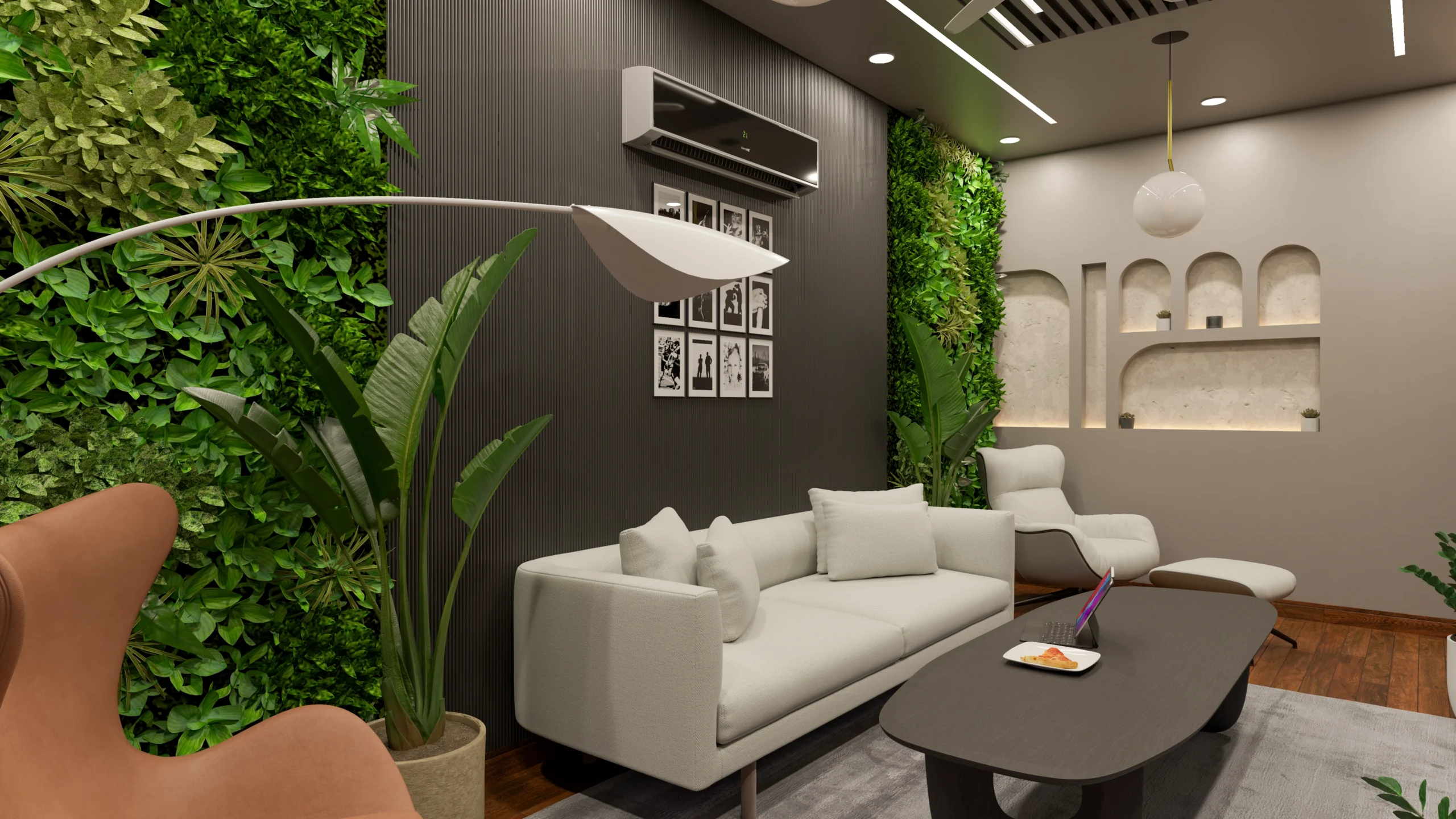
I am writing this from a quiet corner of a gallery in Mayfair, where a single Giacometti sculpture stands at the precise centre of an otherwise empty room. There is no clutter, no competing narrative, no visual noise. There is only the figure, the light falling at an oblique angle from a north-facing skylight, and the profound, almost physical sensation of stillness. It is the kind of stillness that architectural balance produces when it is executed with absolute conviction, and it is the very quality I find myself returning to, again and again, in every project I undertake. Architectural balance in interior design is not merely a compositional technique; it is a philosophy of living, a quiet insistence that our environments should restore us rather than deplete us.
The world beyond our walls has never been louder. Notifications, obligations, the relentless acceleration of modern commerce: all of it conspires to fracture our attention and exhaust our nervous systems. And yet, when we step into a room that has been designed with genuine spatial intelligence, something remarkable happens. The shoulders descend. The breath slows. The mind, so accustomed to its own restless chatter, finds a moment of genuine repose. This is not coincidence. It is the direct result of deliberate architectural choices, of proportions honoured, of axes respected, of materials selected for their capacity to absorb and reflect light in equal measure. It is, in the most literal sense, peace made visible.
Proportion, Scale, and the Discipline of Restraint
The Golden Ratio and Its Modern Descendants
Proportion is perhaps the most intellectually demanding aspect of architectural balance in interior design, and the one most frequently sacrificed in the pursuit of trend or novelty. The classical tradition gave us the golden ratio, that mathematical relationship between parts and whole that appears with uncanny regularity in natural forms, from the spiral of a nautilus shell to the branching of a river delta. Its application in architecture and interior design produces spaces that feel, without the observer necessarily understanding why, inherently right. The ceiling height in relation to the room’s width, the scale of a fireplace surround in relation to the wall it occupies, the proportion of a rug in relation to the furniture grouping it anchors: these are not arbitrary decisions but precise calibrations that either honour or violate the room’s fundamental geometry.
What strikes me, after two decades of working in this discipline, is how rarely proportion is discussed in the popular conversation about interior design, which tends to fixate on colour palettes and material trends at the expense of the underlying spatial logic that determines whether any of those choices will ultimately succeed. A beautifully selected palette applied to a room of poor proportions will always feel slightly wrong, in the way that a perfectly tailored jacket worn on a frame it was not made for will always betray its misalignment. Proportion is the foundation upon which everything else rests, and it demands to be addressed first.
The Edit as an Act of Courage
Restraint, in a culture that equates abundance with success, requires a particular kind of confidence. The impulse to fill every surface, to justify every square metre with an object or a gesture, is understandable but ultimately self-defeating. A room that has been edited with genuine rigour, where every element has earned its place through a process of considered selection and deliberate placement, communicates something that no amount of accumulation can replicate. It communicates mastery. It communicates the quiet assurance of someone who understands that what is removed from a space is as significant as what is placed within it.
- Honour the axis: Identify the primary sight line in every room and compose the space in deliberate relationship to it, ensuring that the eye is guided rather than scattered.
- Respect visual weight: Balance dense, dark, or highly textured materials with lighter, more recessive ones to achieve equilibrium without monotony.
- Layer your light: Never rely on a single light source; instead, compose a hierarchy of ambient, task, and accent illumination that creates depth and visual rhythm.
- Proportion before palette: Resolve the spatial proportions of a room before committing to any material or colour decision, as proportion is the architecture upon which everything else depends.
- Edit with conviction: Remove any element that does not contribute actively to the room’s composition; restraint is not poverty but precision.
- Invest in raw materials: Marble, aged timber, patinated metal, and natural stone carry an inherent visual authority that manufactured alternatives cannot replicate, and they age with a dignity that rewards long-term investment.
- Consider the negative space: The empty areas of a room are as compositionally significant as the occupied ones; treat them as deliberate choices rather than failures of decoration.
The Emotional Architecture of a Balanced Space
How Balance Shapes Behaviour and Mood
The relationship between architectural balance in interior design and human psychology is one that neuroscience is only beginning to articulate with the precision that designers have long understood intuitively. Environments characterised by visual order, clear spatial hierarchy, and harmonious proportion consistently produce measurable reductions in cortisol levels, the physiological signature of stress. They encourage slower movement, deeper conversation, and a quality of presence that our increasingly fragmented attention rarely achieves in less considered surroundings. This is not a trivial observation. For the business leader who requires genuine restoration at the end of a demanding day, or the family that wishes its home to function as a genuine sanctuary rather than a mere storage facility for possessions, the emotional architecture of a balanced space is not a luxury but a necessity.
I think often of a project I completed some years ago in a Georgian townhouse in Belgravia, where the client’s primary brief was simply to feel calm upon entering the front door. Every decision we made, from the pale Venetian plaster on the entrance hall walls to the single, oversized lantern suspended at precisely the right height above the staircase, was governed by that single intention. The result was a space that several visitors described, independently and without prompting, as feeling like a deep breath. That is the ambition. Not to impress, not to perform, but to restore.
Silence as a Design Outcome
There is a particular quality of silence that a truly balanced room produces, a silence that is not the absence of sound but the presence of order. It is the silence of a library at dusk, of a cloister in the early morning, of a museum gallery after the last visitor has departed. It is the silence that allows thought to expand and the nervous system to recalibrate. Achieving it requires not only the spatial and material intelligence we have discussed, but also a willingness to resist the cultural pressure to fill every moment and every surface with stimulation. The most sophisticated rooms I have encountered in a career spent travelling between the great interiors of Europe, Asia, and the Americas share this quality above all others. They are rooms that know when to stop. And in that knowing, they achieve something that transcends decoration entirely: they become, in the truest sense, architecture for the soul.
Perhaps the most honest question we can ask of any space we inhabit is not whether it is beautiful, but whether it makes us better. Whether it slows us down, sharpens our thinking, deepens our relationships, and returns us, each morning, to something resembling our best selves. Architectural balance, pursued with rigour and genuine spatial intelligence, is one of the most powerful means we possess of answering that question in the affirmative. I would be genuinely curious to know: which spaces in your own life have offered you that quality of restorative silence, and what, on reflection, do you believe made them feel that way? I invite you to share your thoughts below.
The architecture of your legacy is defined not merely by the objects you choose, but by the standard of life you refuse to compromise on. At The Shape Interiors, we specialise in the silent language of luxury, transforming raw space into sophisticated environments that resonate with the human spirit and professional excellence. Whether you are defining a private sanctuary or a global corporate headquarters, the requirement remains the same: a vision executed with absolute precision.
We invite you to explore our work and discover why the world’s most discerning individuals trust us with their most personal and professional environments.
Refine Your World.
Your journey toward an unparalleled environment begins with a single conversation. Connect with our global design team to initiate your bespoke project.