
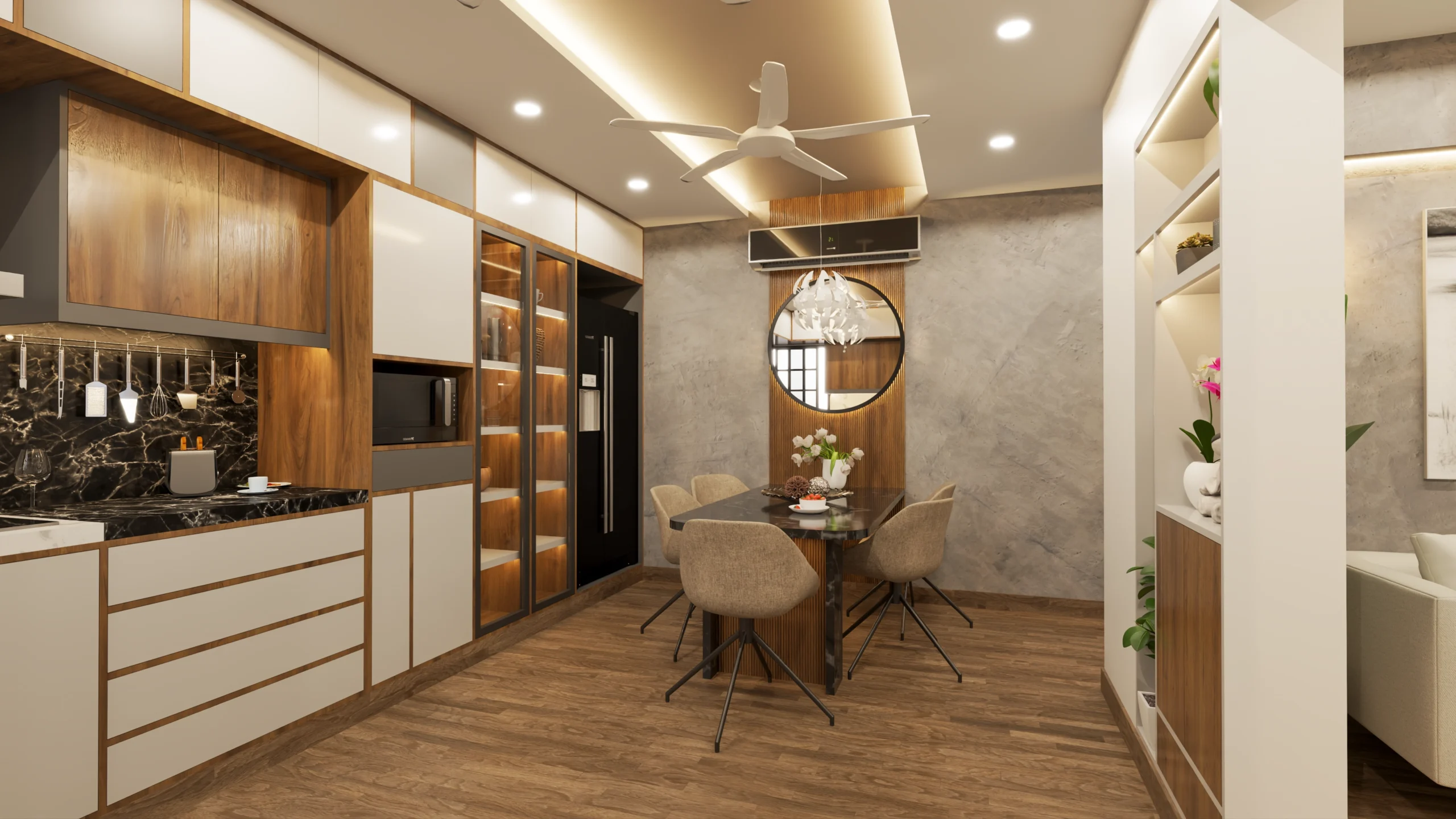
I am writing this from a quiet corner of a gallery in Mayfair, where a slab of raw travertine leans against a whitewashed wall, catching the grey London afternoon light in a way that makes it look almost warm. Almost southern. It reminds me, quite viscerally, of a morning I spent in a Sicilian farmhouse three summers ago, where the floors had been worn smooth by centuries of bare feet and the walls held the faint, mineral scent of the earth they were carved from. That memory, that particular quality of light on ancient stone, is precisely what I find myself returning to again and again when I think about Mediterranean interior design and its extraordinary capacity to translate a sense of place into the very bones of a room.
There is something profoundly intelligent about the way Mediterranean architecture has always understood material. Long before the language of “biophilic design” entered our professional vocabulary, the builders of Provençal farmhouses and Aegean island homes were already practising it instinctively, selecting stone not merely for its structural utility but for its ability to breathe, to absorb heat, to age with a kind of dignity that synthetic materials simply cannot replicate. It is this material intelligence, this deep respect for the geological and the tactile, that I believe holds the most compelling lessons for contemporary luxury interiors. The question, then, is not whether Mediterranean textures belong in a modern London townhouse or a Manhattan penthouse; the question is how to honour their origins while allowing them to speak fluently in a contemporary context.
The Architecture of Warmth: Understanding Mediterranean Interior Design
Stone as a Living Material
To understand Mediterranean interior design at its most essential, one must first understand stone not as a surface but as a presence. Limestone quarried from the hills above Lecce carries within its pale, honeyed body the compressed memory of ancient seabeds. Travertine, with its characteristic voids and veining, speaks of thermal springs and geological time. These are not merely decorative choices; they are decisions that introduce a geological narrative into a domestic space, a quiet insistence that the room exists within a larger, older story than the one we are currently living. When I specify a honed travertine floor for a client’s entrance hall, I am not simply selecting a material; I am selecting a philosophy, one that values permanence over trend and depth over surface.
The Thermal Logic of Natural Stone
There is also a deeply practical intelligence embedded in the Mediterranean tradition of stone interiors, one that speaks directly to the contemporary conversation around sustainable luxury. Stone floors and walls absorb heat during the day and release it slowly through the evening, creating a natural thermal rhythm that is both energy-efficient and profoundly comfortable. In a well-designed space, this thermal mass becomes part of the sensory experience of the room itself; the floor is cool underfoot in the morning, warmer by late afternoon, and the walls hold a gentle residual warmth long after the sun has moved on. This is design that works with the body’s own rhythms, and it is, I would argue, one of the most sophisticated forms of spatial intelligence available to us.
Colour as Geography
The colour palette of the Mediterranean is not a trend; it is a geography. The bleached whites of Santorini, the ochres and terracottas of Tuscany, the dusty sage greens of Provence, these are colours that have been refined over centuries by the particular quality of southern light, by the way the sun at a certain latitude saturates and bleaches simultaneously. When we bring these tones indoors, we are not simply making a decorative choice; we are importing a quality of light, a sense of latitude, a particular emotional temperature. Used with restraint and material honesty, they create interiors of extraordinary warmth and psychological ease.
Material Conversations: Pairing Stone with Aged Leather and Raw Linen
The Art of Textural Dialogue
Mediterranean interior design has always understood that stone, for all its beauty, requires conversation. A room composed entirely of hard, cool surfaces risks becoming a monument rather than a home, impressive but uninhabitable. The genius of the Mediterranean tradition lies in its instinctive understanding of textural counterpoint: the rough-hewn stone wall softened by a length of undyed linen, the travertine floor warmed by a hand-knotted wool rug, the marble table anchored by the deep, burnished weight of aged leather seating. These pairings are not accidental; they reflect a sophisticated understanding of how materials speak to one another, how warmth and coolness, softness and hardness, create a sensory balance that is deeply satisfying to inhabit.
Aged Leather and the Patina of Time
If stone is the geological anchor of a Mediterranean-inspired interior, then aged leather is its human counterpart. There is a quality to leather that has been properly tanned and allowed to develop its patina over years of use that no synthetic material can approach, a depth of colour, a suppleness of surface, a faint, complex scent that speaks of craft and time. In the context of a stone-rich interior, aged leather introduces a note of warmth and human scale that is essential. A pair of deep, cognac-coloured leather armchairs beside a limestone fireplace does not merely look beautiful; it creates a specific emotional register, one of ease, of permanence, of a life lived with considered pleasure.
Linen, Terracotta, and the Unfinished Edge
Raw linen and terracotta are perhaps the most honest materials in the Mediterranean palette, and their honesty is precisely their luxury. Linen, with its slight irregularity of weave and its tendency to soften and drape more beautifully with every wash, is the antithesis of the fast-furniture aesthetic. Terracotta, whether in the form of handmade floor tiles or a collection of aged vessels, carries within it the memory of the potter’s hand, the particular clay of a particular region, the heat of a particular kiln. These are materials that reward close attention, that reveal more of themselves over time rather than less, and in a world saturated with the immediately legible, that quality of slow disclosure is, I believe, the truest form of luxury.
Spatial Philosophy: Editing the Mediterranean Room
The Discipline of Restraint
One of the most common misreadings of Mediterranean interior design is the assumption that it is about abundance, about terracotta pots and draped fabrics and sun-bleached textiles layered without limit. In reality, the most beautiful Mediterranean interiors I have encountered, from a restored masseria in Puglia to a contemporary villa above the Côte d’Azur, have been defined by a rigorous editorial discipline. The stone is allowed to speak without competition. The furniture is sparse but considered. The light, whether natural or artificial, is treated as a material in its own right. It is this quality of restraint, of knowing precisely what to remove as well as what to include, that separates a truly refined Mediterranean-inspired interior from a merely decorative one.
Light as the Primary Material
In Mediterranean architecture, light is not an afterthought; it is the primary design material, the element around which everything else is organised. The deep-set windows of a Moroccan riad, the whitewashed walls of a Greek island home, the terracotta brise-soleil of a Spanish courtyard: all of these are sophisticated light-management systems, designed to filter, diffuse, and dramatise the quality of natural illumination throughout the day. When we bring Mediterranean textures indoors in a northern climate, we must compensate for the absence of that particular quality of southern light with an equally considered approach to artificial lighting. Warm, low-level sources that graze across stone surfaces to reveal their texture, pools of amber light that echo the quality of late afternoon sun, these are the tools that allow a stone-rich interior to feel alive rather than cold.
- Specify honed or brushed stone finishes rather than polished, to preserve the material’s natural texture and prevent the clinical quality of high-gloss surfaces.
- Introduce aged leather in deep, warm tones such as cognac, tobacco, or antique saddle to provide human warmth against cool stone.
- Layer natural textiles including undyed linen, raw wool, and hand-loomed cotton to soften acoustic and visual hardness without compromising material integrity.
- Limit the palette to three or four tones drawn from the geological and botanical world: limestone, terracotta, sage, and bleached oak are a complete and sufficient vocabulary.
- Treat light as a material by specifying warm-toned, low-level sources that graze stone surfaces and create the quality of late Mediterranean afternoon light.
- Edit with severity: every object in a Mediterranean-inspired interior should earn its place through material quality, provenance, or emotional resonance, never through mere decoration.
The Global Relevance of Mediterranean Textures in Contemporary Luxury
A Universal Language of Calm
What strikes me most, having worked across London, the Gulf, and Southeast Asia, is how universally the principles of Mediterranean interior design translate. There is something in the combination of natural stone, warm textiles, and restrained spatial organisation that speaks to a deep human need for calm, for groundedness, for the reassurance of materials that have outlasted trends and will continue to do so. In a world of accelerating visual noise, the Mediterranean interior offers something genuinely rare: a quality of silence. Not the silence of emptiness, but the silence of sufficiency, of a room that contains precisely what it needs and nothing more. This is the philosophy that underpins the work we do at The Shape Interiors, and it is, I believe, the most enduring form of luxury available to us.
Stone in the Corporate and Residential Context
The application of Mediterranean textures is not limited to the private residence. Some of the most compelling contemporary commercial interiors I have encountered have drawn deeply from this tradition, using travertine reception desks, limestone-clad feature walls, and terracotta-tiled breakout spaces to create environments that feel genuinely restorative rather than merely impressive. In a corporate context, the choice of natural stone over composite materials sends a clear signal about values: permanence over disposability, quality over economy, a long view over a short one. For the business owner or developer who understands that the built environment shapes behaviour and perception, the material intelligence of the Mediterranean tradition is not an aesthetic indulgence; it is a strategic investment.
The Enduring Conversation Between Place and Material
Perhaps the most profound lesson that Mediterranean interior design offers is this: that the most beautiful spaces are those in which the materials remember where they came from. A slab of Portuguese limestone does not forget the hillside from which it was quarried; it carries that memory in its colour, its texture, its particular way of receiving light. When we bring these materials into our homes and offices, we are not simply decorating; we are establishing a conversation between the built environment and the natural world, between the present moment and geological time. That conversation, quiet and continuous, is what gives a truly well-designed space its quality of depth, its sense that it has always existed and will continue to do so long after we have moved on.
I find myself returning, always, to that Sicilian farmhouse, to the particular quality of morning light on ancient stone, to the way a room can hold within its walls the accumulated weight of time and still feel entirely, perfectly alive. It is that quality, more than any trend or technique, that I am always seeking to recreate, and I suspect it is what you are seeking too. What is the material that, for you, holds that quality of memory and place? I would be genuinely interested to know your thoughts in the comments below.
The architecture of your legacy is defined not merely by the objects you choose, but by the standard of life you refuse to compromise on. At The Shape Interiors, we specialise in the silent language of luxury, transforming raw space into sophisticated environments that resonate with the human spirit and professional excellence. Whether you are defining a private sanctuary or a global corporate headquarters, the requirement remains the same: a vision executed with absolute precision.
We invite you to explore our work and discover why the world’s most discerning individuals trust us with their most personal and professional environments.
Refine Your World.
Your journey toward an unparalleled environment begins with a single conversation. Connect with our global design team to initiate your bespoke project.