
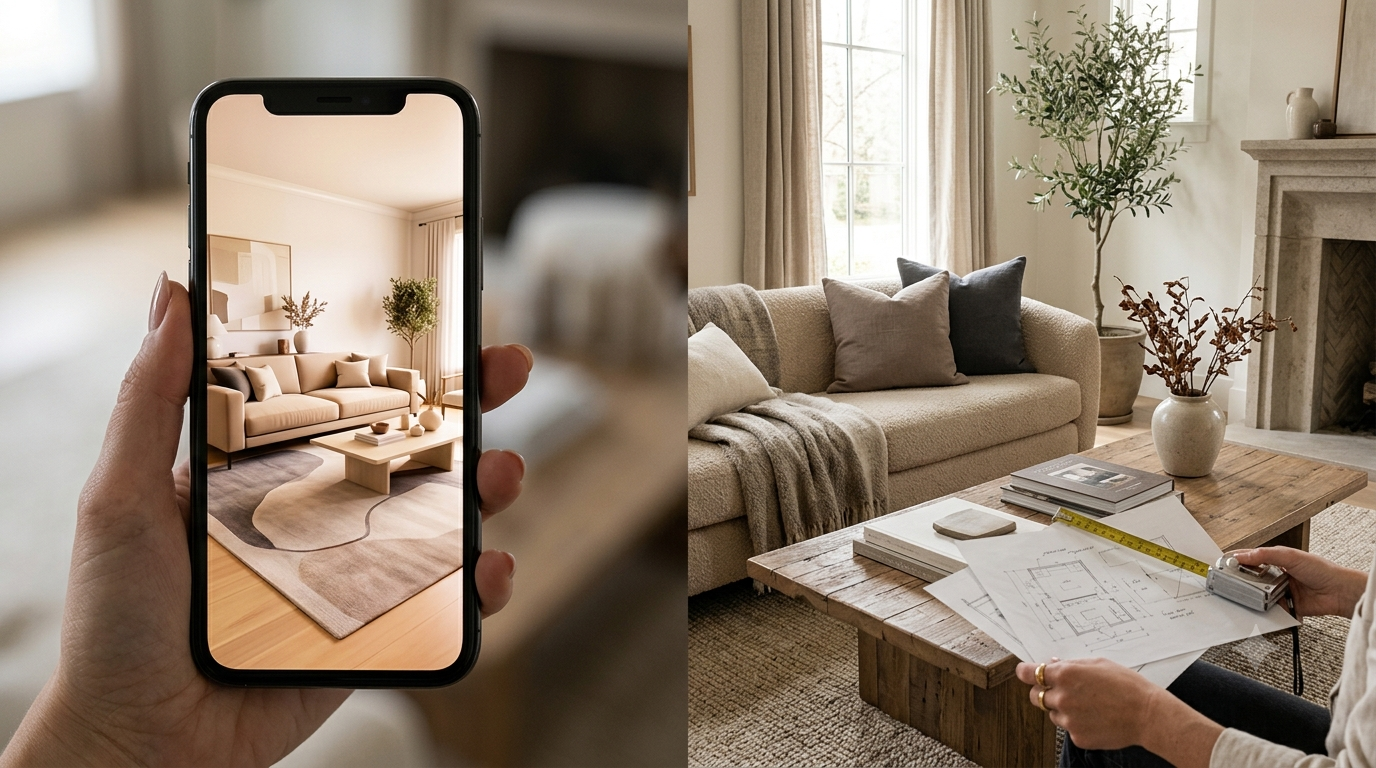
It’s 1 AM. You’re lying in bed, phone in hand, typing “modern living room design” into an AI app. Within seconds, a beautiful image appears — soft neutral tones, a statement sofa, warm layered lighting. It looks exactly like the kind of space you’ve been dreaming about.
You save it. You screenshot it. And then, quietly, a question creeps in: Is this actually going to work in my room?
That question is the reason you’re reading this. In 2026, AI design tools are everywhere. They’re fast, free, and endlessly creative. At the same time, professional studios like The Shape Interiors continue to be trusted with real homes, real offices, and real budgets, project after project.
So which one should you actually rely on?
The honest answer isn’t “AI is bad” or “designers are outdated.” It’s more nuanced than that. Understanding the nuance will save you time, money, and a lot of frustration down the road. Let’s break it down properly, without bias in either direction.
What Exactly Are AI Interior Design Tools?
AI interior design tools are apps and platforms that use artificial intelligence to generate room designs, mood boards, or style suggestions. You type a prompt, or upload a photo of your empty room, and within seconds you get a polished, styled image. It shows what that space could look like.
They’ve become popular for a simple reason. They remove the blank-page problem. Not everyone knows what “their style” is. Not everyone can picture how a sofa, a rug, and a pendant light will look together in real life.
AI tools solve that instantly, and that’s genuinely valuable, especially in the earliest stage of thinking about a space. But generating an image and designing a livable, buildable space are two very different problems. Understanding that difference is the entire point of this article.
Why This Question Is Even Coming Up in 2026
A few years ago, nobody was asking this question. The tools simply didn’t exist in any usable form. Today, AI-powered design apps are built into phone galleries, home décor platforms, and even social media filters.
Typing a prompt and getting a photorealistic room design has become as normal as searching for a restaurant online. At the same time, more people than ever are renovating homes, moving into new apartments, or opening small businesses like cafés and boutiques. All of these need thoughtful interior planning.
Naturally, the first instinct for a lot of people is to open an app before picking up the phone to call a designer. It’s free, it’s instant, and it feels like progress. The problem isn’t that people turn to AI first. The problem is when they assume that’s also where the process should end.
What AI Design Tools Actually Do Well
Let’s give credit where it’s genuinely due. Pretending AI tools are useless would be dishonest, and you’d see right through it anyway. Here are the real strengths worth acknowledging.
The Genuine Strengths of AI Tools
If you’re just exploring ideas casually, there’s nothing wrong with using AI tools for exactly that purpose. The mistake only happens when people treat the output as a finished plan, rather than a starting point.
Instant Visual Inspiration
If you have no idea where to start, AI tools are excellent at giving you one. Type a mood, a color, or a style, and you’ll have dozens of visual directions within minutes. For someone who has never thought seriously about design before, this alone can be genuinely eye-opening.
Zero-Cost Experimentation
You can try ten different styles for the same room without spending a single rupee. Want to see your living room in a warm earthy palette, then a cool minimalist one? AI lets you flip between them instantly, with no commitment.
Great for Undecided Clients
Many people don’t know their own taste until they see it in front of them. AI tools act like a visual questionnaire. Showing you a range of options helps you figure out what you actually respond to. In fact, many of our own clients arrive at their first consultation with a folder of AI-generated inspiration already saved.
Available Anytime, Anywhere
No appointments, no waiting, no travel. If inspiration strikes at 1 AM, the tool is right there on your phone, ready whenever you are.
Where AI Tools Fall Apart in Real Projects
This is where things get practical. This isn’t about AI “lacking creativity” or “not understanding beauty.” AI-generated renders are often genuinely stunning visually. The real problem is entirely physical and logistical. An app, no matter how advanced, cannot do certain things that a real space demands.
The Practical Gaps Nobody Talks About
Each of these gaps sounds small on its own. Together, they explain why so many AI-inspired projects hit unexpected walls once construction actually begins.
AI Doesn’t Measure Your Actual Room
This is the single biggest gap, and it trips up almost everyone. That AI-generated image of a spacious living room has no idea your actual room is smaller, has a column in the corner, or a door that swings inward. The design looks flawless, until you try to fit it into your real walls.
AI Doesn’t Know What’s Structurally There
Beams, columns, plumbing lines, and electrical points don’t exist in an AI-generated render, because the tool has never seen your actual site. A beautiful open-plan kitchen island might look effortless in the image. If there’s a gas line exactly where that island needs to go, the design can’t be built as shown.
AI Doesn’t Know Local Material and Supplier Realities
A render might show an imported marble finish or a specific lighting fixture that photographs beautifully. What it won’t tell you is whether that material is available in Pakistan, or what it actually costs here. This is where people often get an unpleasant surprise once real sourcing begins.
AI Generates Pictures, Not Buildable Plans
There’s a big difference between an image and a plan a contractor can execute. A render doesn’t include measurements, material specifications, or construction sequencing. Handing your contractor an AI image and saying “make it look like this” almost always leads to confusion and costly improvisation.
No Accountability When Things Go Wrong
If an AI-suggested layout doesn’t work once construction starts, there’s no one to call. No one to revise the plan with you. No one standing on-site solving the problem in real time. With a professional studio, that accountability is built into the process from day one.
Zero Awareness of Your Actual Lifestyle
AI doesn’t know you work from home three days a week and need a quiet corner. It doesn’t know you have young kids and need durable, easy-to-clean materials. A real consultation captures this context. A text prompt to an app simply cannot.
What a Professional Interior Design Studio Actually Gives You
This is where the value of working with a dedicated studio becomes clear. It isn’t a sales pitch. It’s a practical comparison of what’s actually involved in taking a space from idea to reality.
Real Understanding of Your Space and Lifestyle
At The Shape Interiors, every project begins with genuinely understanding how you live or work. It’s not just about what you want the space to look like. A proper consultation covers your daily routine, your priorities, and your budget. It also considers the practical constraints of your actual space, so the design solves real problems, not just picture-perfect ones.
Accurate Measurements and Technical Planning
Professional 3D layout planning accounts for the exact dimensions of your space. Every column, every doorway, every awkward corner is factored in. This ensures furniture and design elements fit exactly as intended, with nothing left to guesswork.
Photorealistic, Buildable Visualization
There’s a meaningful difference between an AI-generated mood image and a professionally developed 3D model. A proper 3D visualization is built on your actual room measurements. It incorporates real material specifications and lighting, with 360° views, so you experience the space accurately before a single wall is touched.
Material and Budget Guidance Rooted in Reality
Instead of showing you an imported finish that isn’t available locally, a professional studio recommends materials that are sourceable and durable. These stay aligned with your actual budget, while still achieving the aesthetic you originally fell in love with.
A Structured, Transparent Process
From the initial consultation through to final delivery, a professional process is built around clarity at every stage. You always know what’s happening, what it costs, and what comes next. There are no surprise costs and no vague timelines.
Someone Accountable, From Concept to Execution
If something needs adjusting mid-project, there’s a real, experienced team behind the design. They can revise the plan, guide your contractor directly, and ensure the final result matches what was promised, not just what was imagined.
A Simple Real-World Example
Imagine you use an AI tool and generate a striking image for your bedroom. A floating bed frame, a deep emerald accent wall, and a statement pendant light hanging low over the bed. It looks incredible on screen.
Now imagine bringing that same idea into a real consultation. A designer reviews your measurements and photos, and identifies a few issues. Your ceiling height doesn’t comfortably support a low-hanging pendant. A floating bed frame isn’t structurally practical given your wall type. The exact emerald paint finish isn’t easily available locally, but a closely matching alternative would achieve nearly the same richness, at half the cost.
The result isn’t a rejection of your AI-inspired idea. It’s a refined, buildable version of it. It keeps the spirit of what you loved about the original image, while making sure it actually works in your real bedroom. This is exactly the kind of problem-solving that separates a quick app-generated image from an ongoing, expert design process.
AI Versus a Professional Studio, Compared Honestly
When you strip away the marketing language on both sides, the practical differences come down to a few clear points. AI tools give you a first idea instantly, while a professional studio requires a proper consultation to get started, but delivers something that’s actually built for your space.
Cost, Starting Point, and Structural Awareness
Exploring ideas with AI costs little to nothing, whereas a studio consultation is a structured, paid step, precisely because it involves real technical work, not just image generation. AI-generated designs tend to be generic and unmeasured, while a studio’s work is based on your room’s real dimensions, from day one.
Structural awareness is where the gap widens further. AI has no knowledge of your columns, beams, or utility lines, while a professional studio accounts for every one of them before finalising a layout. The same is true for material sourcing. AI offers no local guidance at all, while a studio recommends options that are realistically available and budget-appropriate in Pakistan.
Buildability, Support, and Accountability
Buildability is often the biggest surprise for people relying purely on AI. Many AI-generated designs simply aren’t executable as shown, while a studio’s designs are developed specifically to be built exactly as presented. Revisions and support follow the same pattern. AI offers none once you’ve generated an image, while a professional process includes structured revision rounds and ongoing guidance.
Accountability is perhaps the clearest differentiator. If something goes wrong with an AI-inspired plan, there’s genuinely no one to call. With a studio, there’s a real team accountable for the outcome, from the first sketch to final execution. And finally, understanding your actual lifestyle, your routines, your family, your work habits, is something no app can capture, but sits at the very center of how a professional design process begins.
Looking at it this way, the two aren’t really direct competitors. They solve entirely different stages of the same journey. One is for dreaming. The other is for building.
Signs You’ve Outgrown the AI Stage of Your Project
If you’re unsure whether it’s time to move from browsing apps to having a real conversation with a designer, a few signs usually make it clear.
When It’s Time to Move Past the App
Any one of these signs on its own is worth paying attention to. If more than one applies to you, it’s a strong signal you’re ready for the next step.
You Keep Generating Images, But Nothing Feels Locked In
If you’ve gone back and forth between dozens of AI-generated styles for weeks, that’s rarely an inspiration problem. It’s usually a decision-making problem. A structured consultation helps translate scattered inspiration into a direction you can actually commit to.
You’ve Started Pricing Materials and the Numbers Don’t Add Up
This is one of the most common turning points. Someone falls in love with an AI-generated look, prices the materials shown, and realises it’s either unavailable locally or far beyond budget. A professional can immediately suggest alternatives that preserve the aesthetic.
You’re About to Talk to a Contractor
This is a critical moment. Contractors work off precise plans, not inspirational images. Walking in with only an AI picture means relying on the contractor to interpret it, and interpretation gaps are exactly where costly mistakes happen.
Your Space Has Structural Quirks
Columns, low ceilings, odd-shaped rooms, and limited natural light are common in Karachi apartments. If your space has any of these, AI-generated ideas need to be adapted by someone who can actually account for them.
Making Your Consultation Count, Using Your AI Inspiration
If you do bring AI-generated ideas into a real consultation, a little preparation goes a long way. It helps the first session become far more productive.
Preparing Before You Walk In
None of this preparation needs to be perfect. Even rough effort here makes a noticeable difference in how quickly a designer can turn your ideas into something buildable.
Save Your Favourites, Not Everything
Don’t bring fifty scattered images. Narrow it down to five or six that genuinely represent what you love, whether it’s colours, materials, or overall mood. This gives a designer a clear, focused sense of your taste.
Take Real Photos and Measurements
Even rough measurements and a few clear photos of your actual room make a real difference. This allows a consultation to move from a general idea, to something that will actually work in your space.
Be Honest About Your Budget Early
The earlier your budget is on the table, the earlier a designer can guide you toward realistic materials and layouts. This avoids falling in love with something that later needs to be scaled back.
Think About How You Actually Use the Space
Beyond aesthetics, think about your daily routine in that room. Storage needs, how often you work from there, and whether guests visit regularly all matter here. These details shape a design far more than any single image ever could.
Why Working With a Boutique Studio Makes a Difference
Not every professional design experience is the same. Large, impersonal firms and independent freelancers both exist alongside boutique studios, and the difference in experience can be significant.
What Sets a Boutique Studio Apart
These differences aren’t just about size. They shape how attentive, consistent, and accountable the entire process feels, from your very first conversation onward.
Personal Involvement, Not a Production Line
A boutique studio typically works with a limited number of projects at a time. This means your space gets genuine attention, rather than being one of dozens moving through an assembly line. At The Shape Interiors, every consultation is a real, focused conversation.
Consistency From Concept to Completion
With a boutique studio, the person who understood your vision at the start is usually involved throughout. That continuity matters. It means less repeating yourself, fewer miscommunications, and a design that stays true to what was originally discussed.
Transparent, Structured Pricing
A common frustration people have with design work, AI-assisted or otherwise, is unclear pricing. A structured studio lays out costs clearly from the first step, so there are no surprises later in the process.
A Process Built on Trust, Not Just Transactions
Good design work is rarely a single transaction. It’s a relationship. Many clients return for future rooms or offices, or refer friends and family, simply because the first experience was handled with honesty and care.
Common Questions Before Making a Decision
A few questions come up again and again when people are deciding between AI tools and a professional studio. Addressing them directly tends to make the decision much clearer.
What People Usually Ask First
These aren’t hypothetical concerns. They’re the exact questions our own clients raise before their first consultation, and the answers usually settle things quickly.
Can I Just Use AI and Skip a Designer to Save Money?
You can, but it’s worth understanding the trade-off. You save on a consultation fee upfront, but risk far higher costs later. Wrong measurements, unavailable materials, and contractor confusion often cost more than the consultation would have.
Is a Consultation Only Worth It for Large Renovations?
Not at all. Even a single room, like a bedroom refresh or a small home office, benefits from accurate measurements and realistic guidance. Smaller spaces often show AI-to-reality gaps the fastest, since there’s less room for error.
Is My AI Inspiration a Wasted Effort If I Hire a Designer?
Not even slightly. It’s actually the ideal starting point. Bringing existing inspiration into a consultation gives a designer a clear sense of your taste immediately, which often makes the entire process faster.
How Do I Know If a Design Is Realistic Before Spending Money?
This is exactly what a professional 3D layout or 3D modelling service is for. It lets you see and verify your actual design, built on your real measurements, before any construction begins.
What a Typical Design Journey Looks Like With Us
Understanding the actual steps involved can make the idea of “hiring a designer” feel far less intimidating than it sounds.
From First Message to Finished Space
None of these steps require you to already know exactly what you want. The process itself is designed to help you figure that out, gradually and clearly.
The First Conversation
Everything starts with a simple conversation about your space, your goals, and your budget. This is where any AI-generated inspiration you’ve saved becomes genuinely useful, giving the designer an immediate sense of direction. Even a rough idea of what you like is enough to begin.
Understanding Your Actual Space
Next comes gathering real measurements, photos, or a walkthrough of your space. This single step is what separates a professional process from anything an app alone can offer.
Turning Ideas Into a Real Plan
From here, your inspiration is translated into an actual layout and, where needed, a full 3D model. You get to see your space rendered accurately, with real materials and real proportions.
Refining Until It’s Right
Revisions happen at this stage, so the final plan reflects exactly what you want, adjusted for what’s practical and buildable in your specific space.
Supporting You Through Execution
Even after the design is finalised, guidance continues, helping you or your contractor bring the plan to life exactly as intended, without guesswork along the way.
Setting Realistic Expectations From the Start
One honest point worth making is that good design, whether AI-assisted or fully professional, still takes time. Rushing either process usually leads to disappointment.
What “Realistic” Actually Means
Realistic doesn’t mean settling for less. It means understanding the actual steps involved, so the final result matches what was promised, without unpleasant surprises along the way. It also means giving each stage the time it genuinely needs.
A consultation typically takes a couple of hours to properly cover your space, your lifestyle, and your goals. A detailed 3D layout or model then takes time to develop accurately, since it’s built around your real measurements rather than a generic template.
Revisions are a normal, expected part of the process, not a sign that something went wrong. Most projects benefit from at least one or two rounds of adjustment before the design feels completely right. Budget conversations happen early and stay transparent throughout, so there’s never a moment where costs feel unclear or unexpected.
None of this is meant to slow you down unnecessarily. It’s meant to protect you from the exact problems that AI-only planning tends to create further down the line, once real construction begins.
Why This Matters More in Pakistan Specifically
Generic AI tools are trained largely on international interiors, materials, and pricing. They have very little genuine understanding of what’s realistically available in Karachi, Lahore, or Islamabad. Local suppliers, import timelines, construction practices, and climate considerations rarely factor into what these tools generate.
A studio rooted in Pakistan, working with local materials and local contractors, closes that gap entirely. This on-ground expertise is exactly what generic AI tools cannot replicate, no matter how good their renders look on a screen. It’s built from years of real projects, not training data.
So, Which One Should You Actually Use?
Here’s the honest answer. Use both, in the right order.
Start With AI, Then Bring In a Professional
Start by using AI tools for initial inspiration. Explore freely. Try different styles, colours, and moods, and save the images that genuinely resonate with you. This is a low-pressure way to figure out your taste before spending anything.
Then bring that inspiration to a real consultation. This is the step most people skip, and it’s the one that determines whether your dream space becomes real, or stays a folder of unused screenshots. A professional consultation tests your AI-inspired direction against your actual room, your actual budget, and your actual life.
If you already have a folder of AI-generated images saved on your phone, that’s a perfect starting point. Rather than guessing whether any of it is achievable, book a consultation with The Shape Interiors. Let a senior designer walk you through what’s realistic, what needs adjusting, and how to get there without wasted spending.
This approach gives you the best of both worlds. The free, exploratory creativity of AI, combined with the precision and craftsmanship of a real design studio.
The Gap Between Inspiration and Execution
AI design tools are a genuinely useful starting point. They help you discover your style and explore ideas freely, so you walk into a design conversation with far more clarity. But a beautiful image is not the same as a livable, buildable, budget-conscious space. That gap, between inspiration and execution, is exactly where real design expertise matters most.
At The Shape Interiors, we believe good design isn’t about chasing whatever looks impressive for a moment on a screen. It’s about strategy, understanding your space, your lifestyle, and your budget so deeply that the result keeps working for you, for years to come.
If you’ve been exploring AI-generated ideas and are ready to see what’s actually possible for your space, we’d love to be part of that next step. Explore our completed projects to see how we’ve turned ideas, AI-inspired or otherwise, into real, thoughtfully executed interiors across Karachi and beyond.
Your Space Deserves More Than a Prompt
Your space deserves more than a prompt. It deserves a plan.
Whether you’re starting completely from scratch, or you already have a phone full of AI-generated inspiration, the next step is the same. A real conversation, with real measurements, about your real space. That’s where design stops being a picture on a screen, and starts becoming somewhere you actually live, work, or welcome guests.
There’s no wrong way to begin this process. Some clients arrive with a single reference image. Others arrive with nothing but a rough idea of a colour they like. Both are perfectly good starting points, because the real work happens in the conversation that follows, not in the image itself.
What matters most is taking that first step, whichever way feels natural to you. Some people prefer to explore AI tools first, building a folder of ideas over a few weeks before reaching out. Others prefer to skip that stage entirely and start with a direct conversation about their space and their goals. Both paths lead to the same place, as long as the final plan is grounded in real measurements, real materials, and real accountability.
Written by The Shape Interiors — Strategic Interior Design & 3D Visualization Studio, Karachi.