
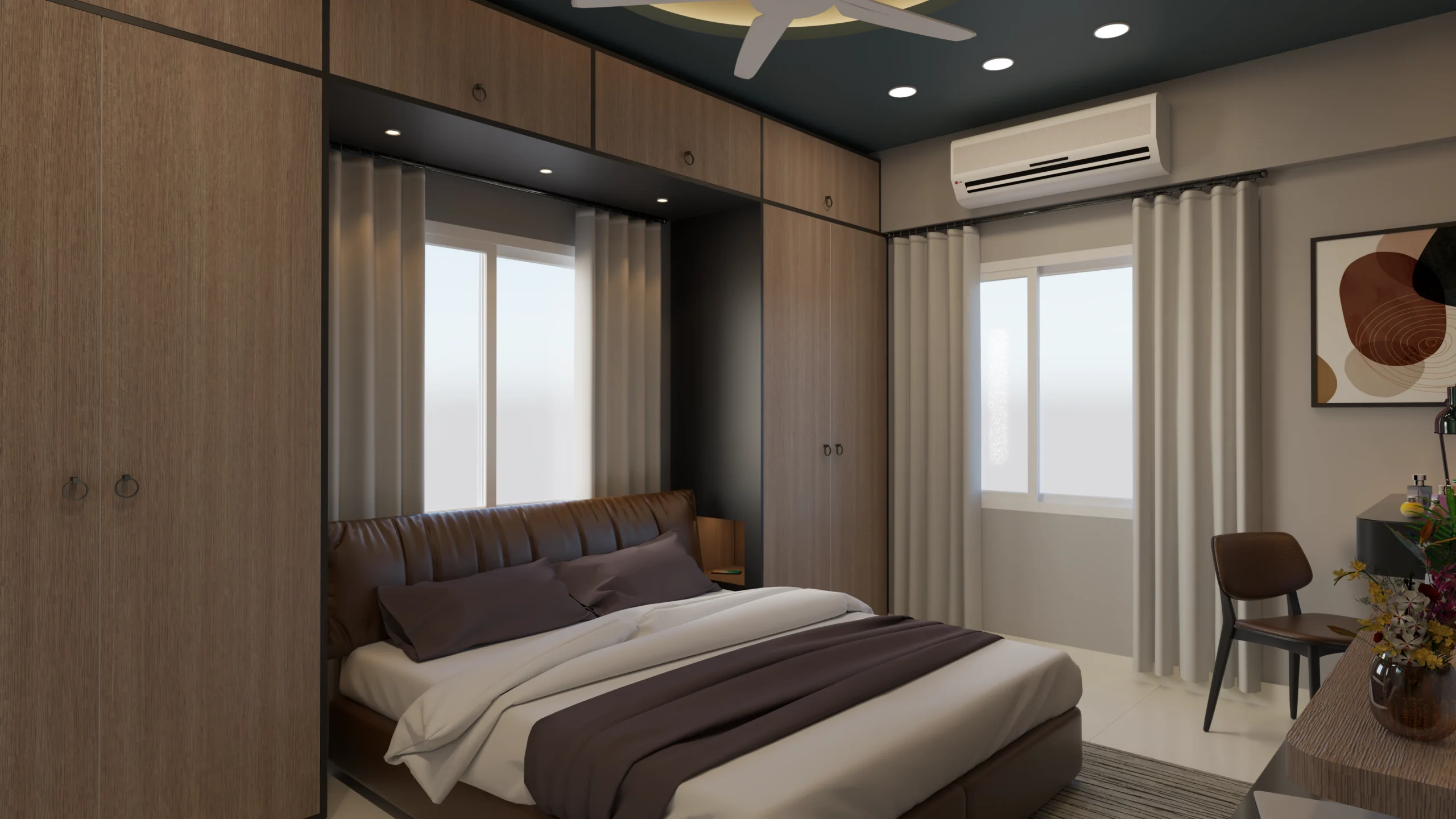
I am writing this from a quiet corner of a gallery in Mayfair, where the afternoon light falls at precisely the angle that reminds me why I chose this profession. There is a particular quality to light in a well-considered room; it does not simply illuminate, it reveals. It traces the grain of aged oak, catches the crystalline edge of hand-cut stone, and settles into the folds of heavy linen like a memory finding its place. It is in moments like this that I am reminded of the central truth I return to again and again in my work: that interior architecture is not decoration. It is narration. It is the art of constructing character within four walls, and it is, perhaps, the most intimate form of storytelling we have.
The narrative power of interior architecture is a subject that deserves far more than a passing mention in a mood board presentation. It demands the kind of slow, considered conversation one might have over a glass of aged Burgundy, with time enough to sit with the ideas and let them breathe. Because when we speak of character in a space, we are speaking of something that cannot be purchased from a catalogue or assembled in an afternoon. We are speaking of the accumulated intelligence of materials, the discipline of proportion, and the quiet authority of a room that knows exactly what it is. That is the conversation I wish to have with you today.
Proportion, Silence, and the Grammar of Space
The Discipline of Proportion
There is a reason the great architectural traditions of the world, from the Palladian villas of the Veneto to the refined minimalism of Japanese machiya townhouses, return obsessively to the question of proportion. It is because proportion is the grammar of space. Without it, even the most beautiful materials become incoherent, like words of great individual beauty arranged without syntax. A ceiling at the correct height does not merely accommodate a room; it governs it. It determines how sound moves, how light falls, how the human body feels in relation to its surroundings. Too low, and a space becomes oppressive, regardless of the quality of its finishes. Too high without the corresponding floor area to balance it, and grandeur tips into theatre, which is a very different thing entirely.
The Power of Deliberate Silence
I have long believed that the most sophisticated design decision a practitioner can make is the decision to leave something out. In a world that equates abundance with success, restraint is a radical act. The empty wall, the unadorned corner, the table with a single object placed upon it: these are not failures of imagination. They are its highest expression. Silence in a room functions as silence does in music; it gives the notes around it meaning, weight, and resonance. When I walk through a space that has been edited with genuine rigour, I feel it physically, a kind of decompression, as though the room itself is exhaling. That sensation is not accidental. It is the result of someone having made very difficult choices with great discipline, and it is, in my view, the clearest marker of true design mastery.
Cultural Reference as Spatial Depth
A room without cultural reference is a room without depth. This does not mean that every interior must be a museum of global artefacts; quite the opposite. It means that the practitioner must bring to each project a breadth of knowledge that allows them to understand why a particular proportion feels correct, why a specific material carries the right emotional register, why the light in a Scandinavian interior behaves differently from the light in a Moroccan riad, and why both of those truths might be relevant to a penthouse in Knightsbridge. The narrative power of interior architecture is inseparable from this kind of cultural literacy. Without it, spaces may be beautiful in a superficial sense, but they will not resonate. They will not endure.
The Edit: Curating Character Over Accumulation
The Philosophy of the Curated Interior
The word “curated” has been somewhat diluted by overuse in recent years, applied to everything from supermarket shelves to social media feeds with a casualness that strips it of its original weight. But in the context of interior architecture, curation retains its full and serious meaning. To curate a space is to exercise editorial judgement of the highest order: to understand not only what belongs, but what must be removed, what must be resisted, and what must be waited for. The finest interiors I have had the privilege of working on at The Shape Interiors have always been the result of this kind of patient, rigorous editing, a process that is as much about subtraction as it is about addition.
The Elena Edit: Design Dictates for Constructing Character
Before we proceed, I want to offer a set of principles that I return to consistently when approaching the question of spatial character. These are not rules in the prescriptive sense; they are orientations, ways of thinking about a space that tend to produce results of lasting quality and genuine distinction.
- Commit to your materials: Choose fewer, better. A room built around two or three exceptional materials will always outperform one assembled from ten mediocre ones. Let the stone be genuinely extraordinary, and let it speak.
- Honour the architecture first: Before introducing a single object, understand the bones of the space. The ceiling height, the window proportions, the structural rhythm of the walls. Design with the architecture, never against it.
- Edit with severity: Remove anything that does not earn its place. If an object does not contribute to the narrative of the room, it is not neutral; it is noise.
- Introduce age deliberately: A single piece of genuine provenance, an antique, a found object, a material with visible history, will do more for the character of a room than any number of new acquisitions.
- Consider the sensory register: Design for scent, texture, and acoustic quality as consciously as you design for the visual. A room that smells of cedar and old books, that absorbs sound softly, that offers varied textures to the hand, is a room that is truly inhabited.
- Resist the trend cycle: Character is built over time and cannot be assembled from this season’s palette. Invest in the timeless and allow the contemporary to arrive organically, through living, not purchasing.
- Light is the final material: Treat natural and artificial light as you would any other specification. Understand how it moves through the space across the day, and design for its best moments.
Living With Intention: The Long Conversation Between Space and Self
The Interior as an Evolving Narrative
One of the most profound shifts I have observed in my clients over the years is the move away from the idea of the “finished” interior. The notion that a space can be completed, signed off, and thereafter preserved in amber is, I think, a fundamentally impoverished way of understanding what it means to live well. The most beautiful homes I have ever visited are those that show evidence of a long, ongoing conversation between the space and the people within it. Books that have actually been read, objects that have been moved and repositioned over years, walls that carry the subtle patina of a life genuinely lived. These are not imperfections. They are the very substance of character.
The Responsibility of the Practitioner
There is a responsibility that comes with shaping the environments in which people spend their most private hours, and I do not take it lightly. When I am commissioned to work on a home or a significant commercial space, I am being invited into a relationship that extends far beyond the transactional. I am being asked to understand how a person moves through the world, what they value, what they need from their surroundings in order to think clearly, to rest deeply, to entertain with genuine generosity. The narrative power of interior architecture is, at its root, a human power. It is the power to make someone feel, upon entering a room, that they have arrived somewhere that understands them. That is not a small thing. It is, in fact, everything.
The spaces we inhabit are not passive backdrops to our lives. They are active participants in the construction of who we are and who we are becoming. Every material we choose, every proportion we honour, every object we elect to keep or to remove, is a statement about what we believe to be worth our attention in this brief and beautiful life. I find myself returning, always, to the same question when I stand in a space for the first time: what is this room trying to say, and does it have the courage to say it clearly? It is a question I hope you will carry with you the next time you walk into a room you love, or one that leaves you inexplicably cold. The answer, I suspect, will tell you more than you expect.
The architecture of your legacy is defined not merely by the objects you choose, but by the standard of life you refuse to compromise on. At The Shape Interiors, we specialise in the silent language of luxury, transforming raw space into sophisticated environments that resonate with the human spirit and professional excellence. Whether you are defining a private sanctuary or a global corporate headquarters, the requirement remains the same: a vision executed with absolute precision.
We invite you to explore our work and discover why the world’s most discerning individuals trust us with their most personal and professional environments.
Refine Your World.
Your journey toward an unparalleled environment begins with a single conversation. Connect with our global design team to initiate your bespoke project.