
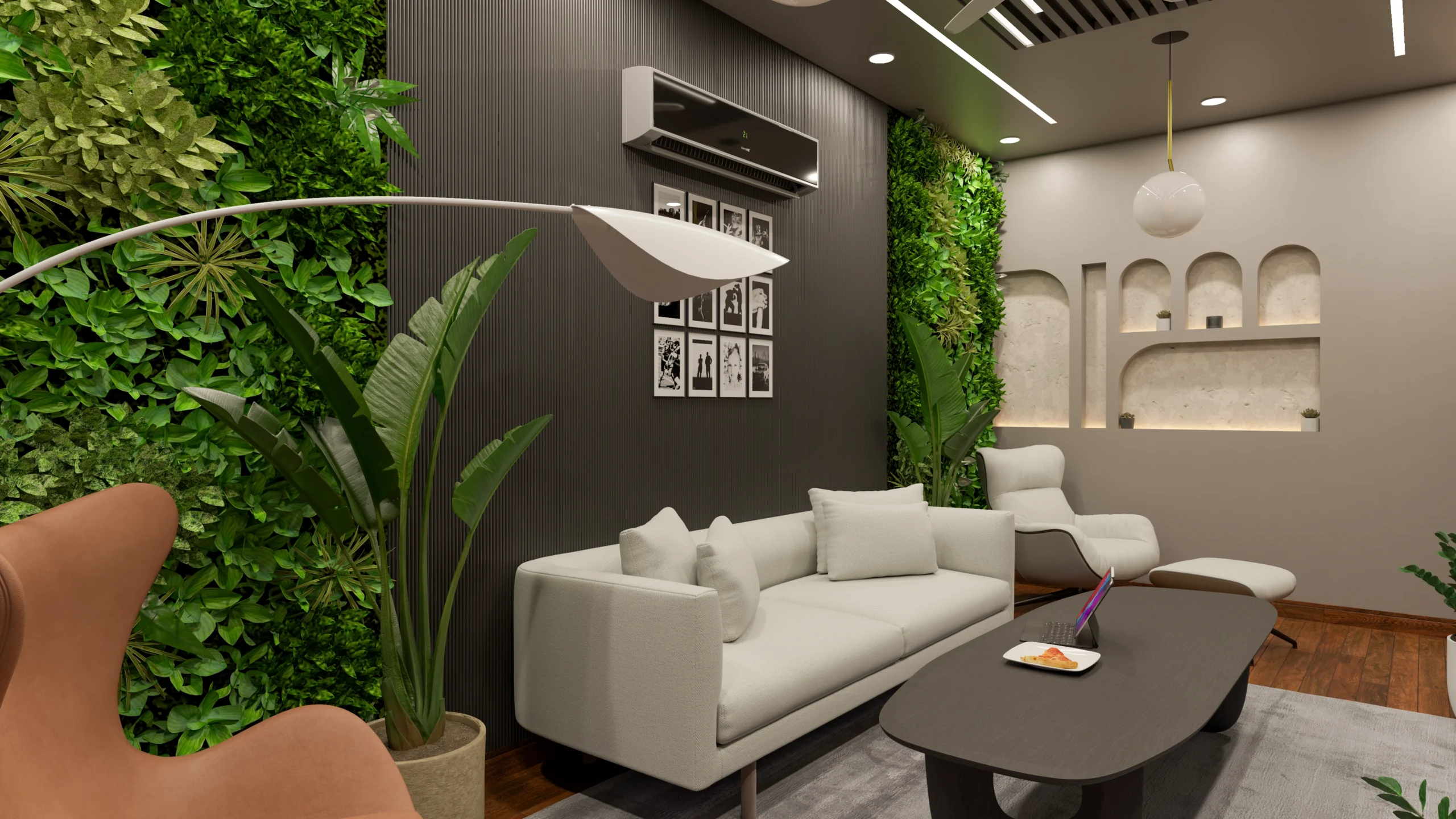
I am writing this from a quiet corner of a gallery in Mayfair, where a single monumental sculpture occupies the centre of an otherwise spare room. There is no clutter, no competing visual noise; only the deliberate, almost mathematical relationship between the object and the space it commands. It is, in the truest sense, a lesson in scale. And it occurs to me, as it so often does in moments like these, that the most sophisticated interiors I have ever encountered share precisely this quality: an almost invisible mastery of proportion that makes every element feel inevitable, as though the room could not have been conceived any other way. Mastering scale is not a decorative flourish; it is the foundational grammar of every truly refined space.
The subject of proportion is one I return to repeatedly, both in my own practice and in the conversations I have with clients who sense that something is wrong with a room but cannot articulate precisely what. They will describe a feeling of unease, a vague dissatisfaction, a sense that the space does not quite breathe. In almost every case, the culprit is scale. A sofa that is too slight for a generous drawing room, a pendant light that hovers too timidly above a dining table, a piece of art that whispers when it ought to speak. These are not failures of taste; they are failures of proportion, and they are entirely correctable once one understands the underlying principles at work.
The Architecture of Proportion: Understanding Scale in Luxury Interiors
The Room as a Living Composition
To understand scale in luxury interiors, one must first abandon the idea that a room is simply a container for furniture. A room is a composition, as deliberate and as structured as a painting by a Renaissance master. Every element within it exists in relationship to every other element, and the success of the whole depends entirely upon the harmony of those relationships. When we speak of mastering scale, we are speaking of the discipline required to honour those relationships at every stage of the design process, from the initial architectural drawings to the final placement of a single object on a shelf.
Consider the grand proportions of a Georgian townhouse in Belgravia. The ceiling heights, the depth of the cornicing, the generous sash windows: all of these architectural features establish a scale that demands to be respected. To furnish such a room with pieces that are too small is to diminish its inherent grandeur, to make it feel provisional and uncertain. Conversely, to overwhelm a more intimate space with oversized furniture is to create a kind of visual aggression, a sense of compression that is deeply uncomfortable to inhabit. The discipline of proportion is, at its heart, the art of listening to what a room is already telling you.
The Golden Ratio and Its Quiet Influence
The ancient Greeks understood something that many contemporary designers have forgotten: beauty is not arbitrary. The golden ratio, that elegant mathematical relationship of approximately 1 to 1.618, appears throughout nature, architecture, and art precisely because it resonates with something deep in human perception. When a room feels harmonious without our being able to say exactly why, it is often because its proportions unconsciously echo this ratio. The height of a bookcase relative to the width of the wall it occupies, the relationship between a coffee table and the sofa it serves, the placement of a mirror above a fireplace: these are all opportunities to apply, consciously or intuitively, the principles of proportional harmony that have governed great design for millennia.
Scale and Material Intelligence: When Weight Meets Space
The Conversation Between Mass and Volume
There is a particular quality of presence that certain materials bring to a room, a sense of weight and permanence that lighter, more transient materials simply cannot replicate. Marble, aged leather, solid bronze, hand-cut stone: these are materials that carry their own gravitational pull, and they must be deployed with a precise understanding of scale if they are not to overwhelm the spaces they inhabit. A marble dining table of generous proportion in a room with sufficient volume is an act of architectural confidence; the same table in a room that cannot absorb its mass becomes oppressive, a statement made without consideration for its audience.
This is what I mean when I speak of material intelligence in the context of proportion. It is not enough to select beautiful materials; one must understand how those materials behave in space, how they interact with light, how their visual weight shifts depending upon the scale of the room and the scale of the other elements within it. A room furnished with raw, weighty materials requires a certain generosity of space to breathe, to allow each piece its moment of authority without crowding the narrative. This is a principle we apply rigorously at The Shape Interiors, where the edit is always as important as the selection.
Light as a Proportional Tool
One of the most underestimated aspects of mastering scale is the role that light plays in shaping our perception of proportion. A room flooded with natural light from generous windows will feel more expansive than its measurements suggest; a room with low, warm artificial light will feel more intimate, more compressed. The skilled designer uses light not merely as illumination but as a spatial tool, one that can elongate a ceiling, widen a corridor, or draw the eye towards a particular architectural feature. The scale of a light fitting is itself a critical decision: a chandelier of insufficient scale in a double-height entrance hall is a missed opportunity of the highest order, a failure to honour the drama that the architecture is inviting.
The Edit: Proportion as a Philosophy of Restraint
Why Less Is a Discipline, Not a Deprivation
There is a common misconception that restraint in design is a form of austerity, a denial of pleasure. In my experience, the opposite is true. The most luxurious spaces I have encountered are invariably those in which every element has been rigorously edited, where nothing exists without purpose and where the relationships between objects have been considered with the same care that a poet brings to the selection of words. Proportion is the engine of this philosophy. When a room contains only what it needs, and when each of those elements is correctly scaled to its environment, the result is a kind of spatial generosity that no amount of accumulation can replicate.
Ask yourself this: have you ever walked into a room and felt an immediate sense of calm, a sense that the space was somehow on your side? That feeling is almost always the product of correct proportion. It is the feeling of a room that has been edited with intelligence and confidence, where the scale of every element has been considered in relation to the whole. It is not a feeling that can be manufactured through the addition of more objects; it can only be achieved through the discipline of knowing what to remove.
The Elena Edit: Design Dictates for Mastering Scale
- Honour the architecture first: Always allow the existing proportions of a room, its ceiling height, its window scale, its structural bones, to inform every subsequent design decision.
- Resist the impulse to fill: Empty space is not wasted space; it is the breath between notes that gives the composition its rhythm and its meaning.
- Consider visual weight alongside physical scale: A dark, dense material will read as heavier than a pale, reflective one, even at identical dimensions. Calibrate accordingly.
- Scale your lighting with conviction: A pendant or chandelier should command its position, not apologise for it. Err on the side of generosity when in doubt.
- Apply the rule of thirds to art placement: Artwork hung at the correct height, in correct proportion to the wall it occupies, can transform the perceived scale of an entire room.
- Edit ruthlessly and repeatedly: The first edit is never the final edit. Return to a space with fresh eyes and remove whatever does not earn its place.
- Invest in scale-defining anchor pieces: A single, correctly proportioned statement piece, a generous sofa, a substantial dining table, will set the scale for everything else in the room.
Proportion Across Cultures: A Global Design Perspective
What Tokyo and Milan Taught Me About Space
My years of working across different cultural contexts have taught me that the understanding of proportion is both universal and deeply particular. In Japan, the concept of ma, the meaningful pause, the intentional emptiness between objects, is a spatial philosophy that has profoundly influenced my own approach to scale. A traditional Japanese interior achieves its extraordinary sense of calm not through abundance but through the precise calibration of what is present and what is absent. The proportions of a tatami room, the relationship between the tokonoma alcove and the single object displayed within it, the way natural light enters at a considered angle: these are lessons in spatial intelligence that transcend cultural boundaries.
In Milan, by contrast, I encountered a different but equally rigorous understanding of proportion, one rooted in the Italian tradition of architectural humanism, the belief that spaces should be scaled to the human body and to human experience. The great Milanese interiors I have had the privilege of visiting share a quality of generous but never excessive scale, a sense that every room has been designed to make its inhabitants feel both comfortable and elevated. This is the paradox of great proportion: it makes a space feel simultaneously grand and intimate, a quality that is extraordinarily difficult to achieve and immediately recognisable when it is present.
Proportion as Emotional Architecture
What moves me most about the subject of scale, and what I find myself returning to again and again in my work, is its emotional dimension. Proportion is not merely a technical consideration; it is a form of empathy. To scale a room correctly is to understand how the people who inhabit it will feel within it, how they will move through it, how they will relate to one another and to the objects around them. A correctly proportioned room is one that makes its inhabitants feel held, supported, and quietly celebrated. It is a room that understands its own purpose and fulfils it with grace.
There is something deeply human about our response to proportion, something that connects us to every civilisation that has ever built a temple, designed a garden, or arranged a table. When we speak of mastering scale, we are speaking of a discipline that is as old as architecture itself, and as relevant today as it has ever been. In a world that increasingly favours the instant and the disposable, the commitment to correct proportion is, in itself, a form of resistance: a quiet insistence that beauty matters, that space matters, and that the relationships between things are worthy of our most careful attention. I wonder, as I leave this gallery and step back into the particular light of a London afternoon, whether you have ever paused to consider the proportions of the spaces you inhabit daily, and what they might be quietly telling you about the life you are living within them.
The architecture of your legacy is defined not merely by the objects you choose, but by the standard of life you refuse to compromise on. At The Shape Interiors, we specialise in the silent language of luxury, transforming raw space into sophisticated environments that resonate with the human spirit and professional excellence. Whether you are defining a private sanctuary or a global corporate headquarters, the requirement remains the same: a vision executed with absolute precision.
We invite you to explore our work and discover why the world’s most discerning individuals trust us with their most personal and professional environments.
Refine Your World.
Your journey toward an unparalleled environment begins with a single conversation. Connect with our global design team to initiate your bespoke project.