
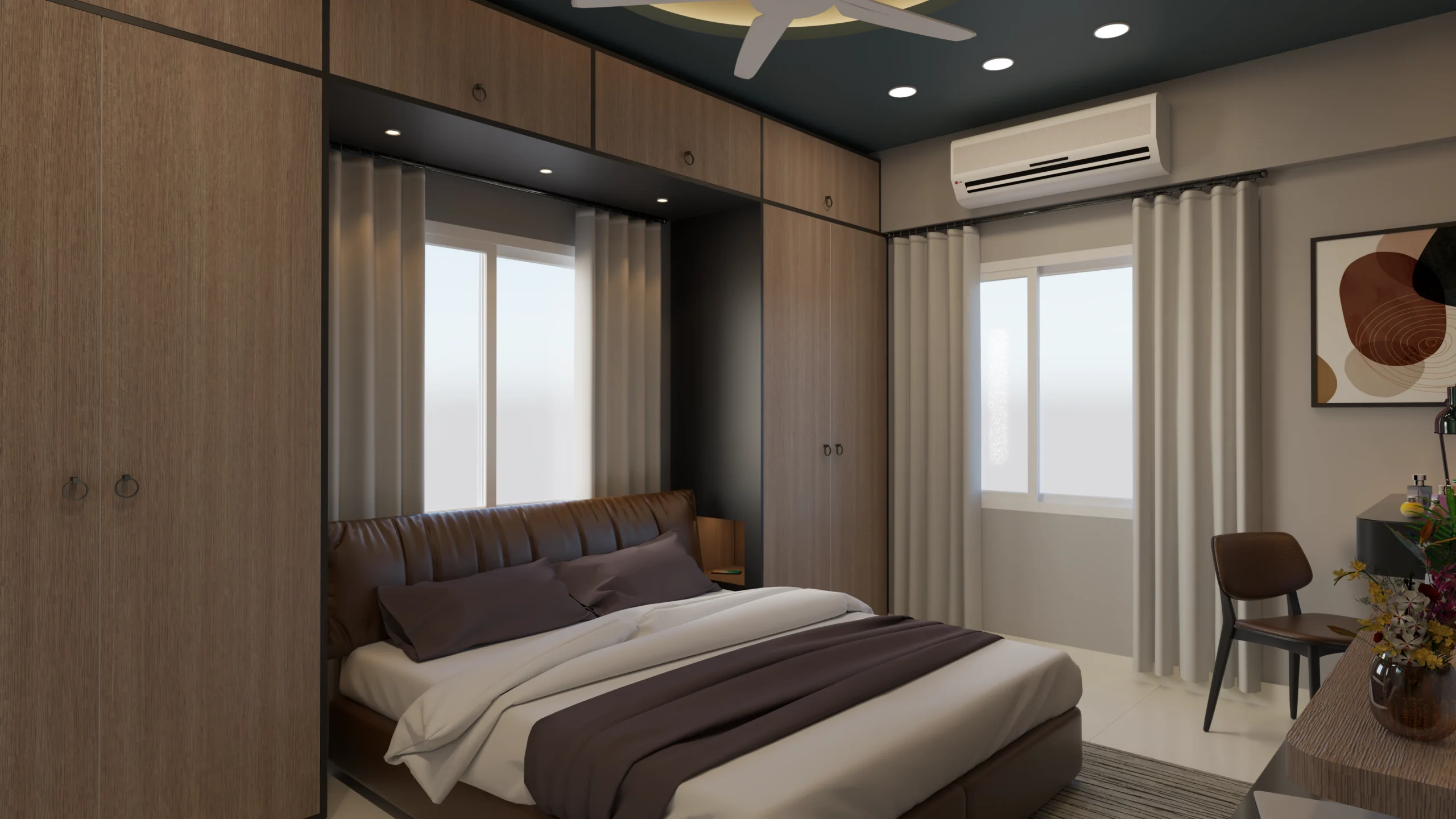
I am writing this from a quiet corner of a gallery in Mayfair, where a single Giacometti sculpture occupies an entire wall of negative space with the kind of confidence that most rooms spend decades trying to achieve. There is a glass of still water on the table beside me, the afternoon light falling across it in a way that feels almost deliberate, as though the architect who designed this room understood that beauty is not arranged but rather allowed. It is in moments like these that I find myself returning to a question that has shaped my entire practice: what does it truly mean to design with intelligence rather than instinct? The intellectual interior is not a style. It is not a mood board or a Pinterest category. It is a philosophy, a commitment to understanding why a space feels the way it does, and it is the only genuine antidote to the relentless churn of visual trends that threatens to reduce our most intimate environments to mere backdrops for social media.
We live in an era of extraordinary visual saturation. Scroll through any platform and you will encounter thousands of beautifully lit rooms, each one more polished than the last, each one somehow indistinguishable from the next. The palette shifts from season to season, the hero material rotates between fluted oak and bouclé and terrazzo, and yet the underlying logic remains the same: design as performance, space as spectacle. I have spent the better part of two decades working with clients across London, Milan, and the Gulf, and what I have observed, consistently, is that the rooms which endure, the ones that clients return to with genuine affection years after the project concludes, are never the ones that chased a moment. They are the ones that asked a deeper question.
Spatial Storytelling and the Architecture of Meaning
Reading a Room as a Narrative
Every room tells a story, whether its designer intended it to or not. The question is whether that story is coherent, whether it has a beginning in the threshold, a middle in the lived experience of the space, and a resolution in the way it makes you feel as you leave it. Spatial storytelling is the practice of designing with narrative intention, of understanding that the sequence of rooms in a home or a corporate headquarters is not merely a logistical arrangement but a choreographed journey. The entry hall sets the tone; it is the opening sentence of the architectural text. The transition from public to private space, from the formal drawing room to the more intimate library or study, should feel like a deepening of the narrative, a gradual revelation of character. When this sequence is handled with intelligence, the result is a space that feels not just beautiful but genuinely inhabited, as though it has a life of its own that extends beyond the hours when people are present.
Light as the Primary Architectural Material
If I were to identify the single most underestimated element in the design of an intellectual interior, it would be light. Not lighting as a technical specification, not the lumens-per-square-metre calculation that appears in a contractor’s brief, but light as a material in its own right, with texture and temperature and the capacity to transform the emotional register of a room entirely. The quality of afternoon light falling across a rough-hewn limestone wall is categorically different from the quality of morning light reflected off a polished plaster ceiling, and a designer who understands this distinction will make entirely different decisions about the orientation of a room, the depth of a window reveal, and the finish of every surface that light will touch. At The Shape Interiors, this understanding of light as a primary material rather than an afterthought is foundational to every project we undertake, from a private residence in Belgravia to a corporate suite overlooking the Thames.
Moving Beyond the Trend Cycle
The Tyranny of the Aesthetic Moment
There is a particular kind of exhaustion that comes from designing within the trend cycle, and I suspect that many of my clients feel it even if they cannot name it. It is the exhaustion of a room that was perfect for approximately eighteen months and then began to feel, quietly and insistently, dated. The arched doorway that felt radical in one season becomes a cliché in the next; the limewash wall that once felt ancient and considered begins to feel merely fashionable. This is the tyranny of the aesthetic moment, and it is a trap that the intellectual interior is specifically designed to avoid. The antidote is not to ignore contemporary design entirely, which would be its own form of affectation, but to engage with it critically, to ask not merely whether something is beautiful now but whether it will be beautiful in twenty years, and why. Timelessness is not the absence of style; it is the presence of conviction.
The Edit as a Design Philosophy
The most powerful tool in the intellectual designer’s repertoire is the edit. Not the addition of more, but the disciplined removal of everything that does not serve the room’s essential argument. I have walked into spaces of extraordinary material quality that felt somehow incoherent, overwhelmed by the accumulation of beautiful things that had no particular relationship to one another. And I have walked into rooms of relative simplicity that felt genuinely profound, because every object present had been chosen with a clarity of intention that was almost palpable. The edit is an act of intellectual courage. It requires the designer, and the client, to resist the impulse to fill every surface, to trust that a single extraordinary object in a well-proportioned room will always outperform a dozen merely beautiful ones competing for attention.
- Anchor the room in a material of genuine provenance: aged stone, hand-stitched leather, or raw silk carry a history that synthetic alternatives cannot replicate, and that history is felt rather than seen.
- Design for the sequence, not the single frame: consider how each room transitions into the next, and ensure that the narrative deepens rather than resets at every threshold.
- Treat light as a material specification: document the quality and direction of natural light at different hours before committing to any surface finish or furniture placement.
- Edit with conviction: remove any object that cannot articulate its reason for being present; a room that breathes is always more powerful than one that accumulates.
- Invest in the permanent over the provisional: architectural decisions, the proportions of a room, the depth of a cornice, the weight of a door, will outlast any decorative trend by decades.
- Allow for silence in the spatial composition: negative space is not emptiness; it is the pause that gives the room’s statement its full weight and resonance.
The Enduring Interior and the Question of Legacy
Designing for Generations, Not Seasons
The clients who commission the most enduring interiors are invariably those who think in terms of legacy rather than lifestyle. They are not designing a room for the next five years; they are designing a home for the next fifty, a space that will absorb the lives of children and grandchildren, that will witness grief and celebration and the quiet ordinary days that constitute the majority of a life. This temporal ambition changes everything about the design process. It elevates the conversation from the decorative to the architectural, from the fashionable to the foundational. A room designed with this kind of longevity in mind will be built on proportions that are classically sound, furnished with pieces of genuine craftsmanship, and finished in materials that improve with age rather than deteriorating under the weight of daily life. It will be, in the truest sense, an intellectual interior: a space that has been thought through rather than merely styled.
The Quiet Authority of a Considered Space
There is a quality that the finest rooms share, a quality that is difficult to articulate but immediately recognisable upon entering. It is a kind of quiet authority, a sense that the space knows exactly what it is and has no need to announce itself. It does not compete for your attention; it simply holds it. This quality is the product of intellectual design, of decisions made with clarity and conviction at every scale, from the proportions of the room itself to the weight of the door handle. It is the quality that separates a space that has been designed from one that has merely been decorated, and it is, I would argue, the most valuable thing that a designer can offer a client. Not a trend, not a moment, but a room that will continue to reward attention and inhabitation for as long as it stands.
I find myself returning, as I prepare to leave this gallery and step back into the particular grey-gold light of a London afternoon, to the Giacometti in the corner. It has not moved, of course. It occupies the same coordinates it did when I arrived. And yet the room around it has shifted, subtly, as the light has changed, as the afternoon has deepened into early evening. The sculpture has not changed, but my experience of it has, and that, I think, is the highest aspiration of the intellectual interior: to create a space that continues to reveal itself over time, that rewards the patient eye and the curious mind, that is never quite finished because it is always, in some essential way, alive. I would love to know what you believe separates a truly intellectual interior from one that merely performs intelligence; please share your thoughts in the comments below.
The architecture of your legacy is defined not merely by the objects you choose, but by the standard of life you refuse to compromise on. At The Shape Interiors, we specialise in the silent language of luxury, transforming raw space into sophisticated environments that resonate with the human spirit and professional excellence. Whether you are defining a private sanctuary or a global corporate headquarters, the requirement remains the same: a vision executed with absolute precision.
We invite you to explore our work and discover why the world’s most discerning individuals trust us with their most personal and professional environments.
Refine Your World.
Your journey toward an unparalleled environment begins with a single conversation. Connect with our global design team to initiate your bespoke project.