
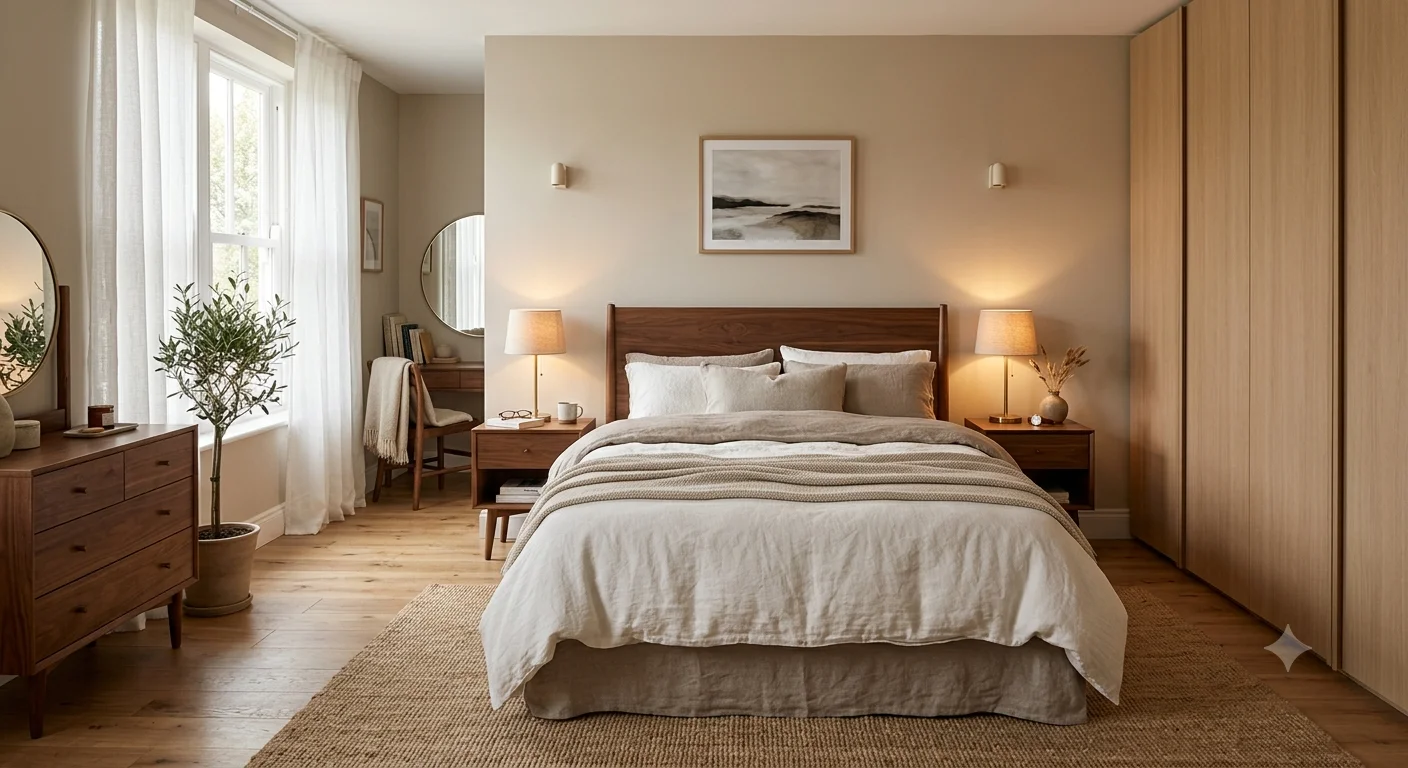
The wedding is over. The guests have gone home, the leftover flowers are wilting in the corner, and you’re standing in a bedroom that suddenly belongs to two people instead of one. Somewhere between the mehndi and the walima, nobody sat you down and explained what this room actually needs. So you do what most couples do — you go to the market, pick a paint color you both sort of like, order a bed that looked good online, and hang a few frames. It looks fine for a photo. Six months in, half of it stops working.
This is not a post about the prettiest newlywed bedroom ideas. There are thousands of those already, and most of them show you cushions, fairy lights, and red accent walls. This post answers the question that actually matters when the budget is limited: what should you spend on first, what can wait, and what can you skip entirely — without ending up with a room that looks fine in photos and stops working within a few months.
Why Couples Get the Order Backwards
Most newly married couples start with the parts of the room they can see — paint color, bedding, a feature wall, maybe a wallpaper the bride liked on Instagram. These are the most visible decisions, so they feel like the most important ones. They are usually the least important ones.
What actually determines whether a bedroom works for two people, every single day, has almost nothing to do with color. It’s sleep quality, storage for two wardrobes instead of one, and lighting that supports two different routines under one roof. None of that photographs well, so nobody puts it in a decor guide. But it’s the difference between a room you love for a week and a room you actually live in comfortably for years.
The Real Priority Order
If you’re working with a limited budget — and almost every newly married couple is — this is the order that actually protects your money and your comfort.
1. The Mattress, Before Anything Else
This is the one thing couples consistently underspend on, because a mattress doesn’t show up in photos. But you will spend roughly a third of your life on it, and now you’re sharing it with someone whose sleep schedule, temperature preference, and movement pattern may be completely different from yours. A mattress that suited one person sleeping alone often does not suit two people sleeping together. Get this right before you spend a single rupee on decor. A beautiful room with poor sleep is still a room where you wake up tired.
2. Storage, Sized for Two People
Almost every newlywed couple underestimates storage, because before marriage, each partner solved their own storage problem separately. Now it doubles overnight, and most existing wardrobes were never designed for two full sets of clothes, shoes, and accessories.
This is the single most common regret couples mention a year in: not enough space, followed by a second, smaller wardrobe added later that never quite matches the room. Sit down together, honestly estimate how much each of you owns, and plan storage for that number — not for what looks minimal and aspirational on a showroom floor.
3. Lighting, Not Just a Bulb Overhead
A newlywed bedroom usually needs to do more than one job. It’s where you sleep, where one of you might read late while the other sleeps, where you get ready separately in the morning, and where you spend quiet time together in the evening. A single central light cannot support all of that.
You don’t need an elaborate setup. A soft ambient light for the evening, a focused reading light on each side of the bed, and a brighter, practical light near the wardrobe or dressing area covers almost every real need. This costs far less than most couples assume, and it does more for how the room actually feels than any paint color will.
4. Wardrobe and Dressing Layout
Once storage capacity and lighting are settled, think about how the space is actually used every morning and night — where each of you gets ready, whether you’re both trying to use the same mirror at the same time, and whether the wardrobe doors can even open fully without hitting the bed. This is a layout conversation, not a shopping conversation, and it’s far cheaper to solve on paper than to fix after the furniture is already in the room.
5. Color and Decor — Genuinely Last
Once sleep, storage, and lighting are sorted, color becomes an easy decision instead of a stressful one. At this stage, a calm neutral base with one or two colors you both genuinely like, rather than a trend color chosen quickly at the paint shop, will serve you far longer. Decor should be the layer that personalizes a room that already works — not the layer you hope will fix a room that doesn’t.
What You Can Skip or Delay Entirely
Just as important as knowing what to prioritize is knowing what not to spend on, especially early on.
Wedding-specific room decoration. Flower arches, fairy light curtains, and “just married” styling look lovely for a week and then either get taken down or quietly gathered in a corner. If you want to spend on this moment, treat it as temporary decor, not part of the room’s actual design budget.
A fully themed room. A heavily themed color scheme or highly specific trend often reflects how you feel in the first few months, not how either of you will feel about the room in three years. One partner’s taste also tends to shift as you actually live together — a room designed around a single strong theme leaves very little room for that.
Over-customized furniture you can’t change later. Built-in pieces in a very specific color or finish are expensive to undo. Where possible, choose furniture and layouts you can update through smaller changes — bedding, artwork, a rug — rather than committing the whole room to one look early on.
Perfect symmetry. Many couples feel pressure to make “his and hers” sides identical. It rarely needs to be. What matters is that each side works for the person using it — a taller partner may need a different light height, a light sleeper may need blackout curtains the other doesn’t care about. Function first, matching second.
A Simple Way to Split the Budget
If you’re working with a fixed amount, a rough and workable split looks like this: half your budget toward sleep and storage — mattress, bed frame if needed, and wardrobe capacity. A third toward lighting and layout — fixtures, layered lighting, and any layout adjustments the room genuinely needs. The remaining portion toward color and decor — paint, bedding, art, and personal touches.
This isn’t a strict formula, but it protects you from the most common pattern: spending most of the budget on the visible layer first, then running short when it’s time to fix the storage or lighting that was actually needed from day one.
The Mistakes That Come Up Again and Again
Buying furniture before measuring the room properly. A wardrobe that looked reasonably sized in the showroom can make a smaller bedroom feel cramped once it’s placed against a real wall, next to a real door swing.
Choosing paint before deciding on furniture. Committing to a wall color early, then building the room around it, often ends in a repaint once the actual furniture and its undertones arrive.
Treating the room as a one-time project. A newlywed bedroom doesn’t need to be finished in the first month. Getting the sleep, storage, and lighting right early, then adding decor and personal touches gradually, produces a far better result than rushing every decision before the wedding rush has even settled.
Assuming a bigger budget fixes bad planning. A large budget spent in the wrong order still produces a room that doesn’t quite work. A modest budget spent in the right order — sleep, storage, lighting, then aesthetics — consistently outperforms it.
Getting the Order Right, Not Just the Look
None of this means color and decor don’t matter — they absolutely do, and they’re often the most enjoyable part of setting up a home together. The point is sequencing. Get the room functioning well for two people first, and the styling decisions become easier, cheaper, and far less stressful, because you’re no longer trying to fix a room that never quite worked in the first place.
If you’d rather skip the trial and error entirely, The Shape Interiors can help you plan a newlywed bedroom the right way from day one — sleep, storage, lighting, and layout worked out properly, with the styling built around a room that already functions.
Written by The Shape Interiors — Strategic Interior Design & 3D Visualization Studio, Karachi.