
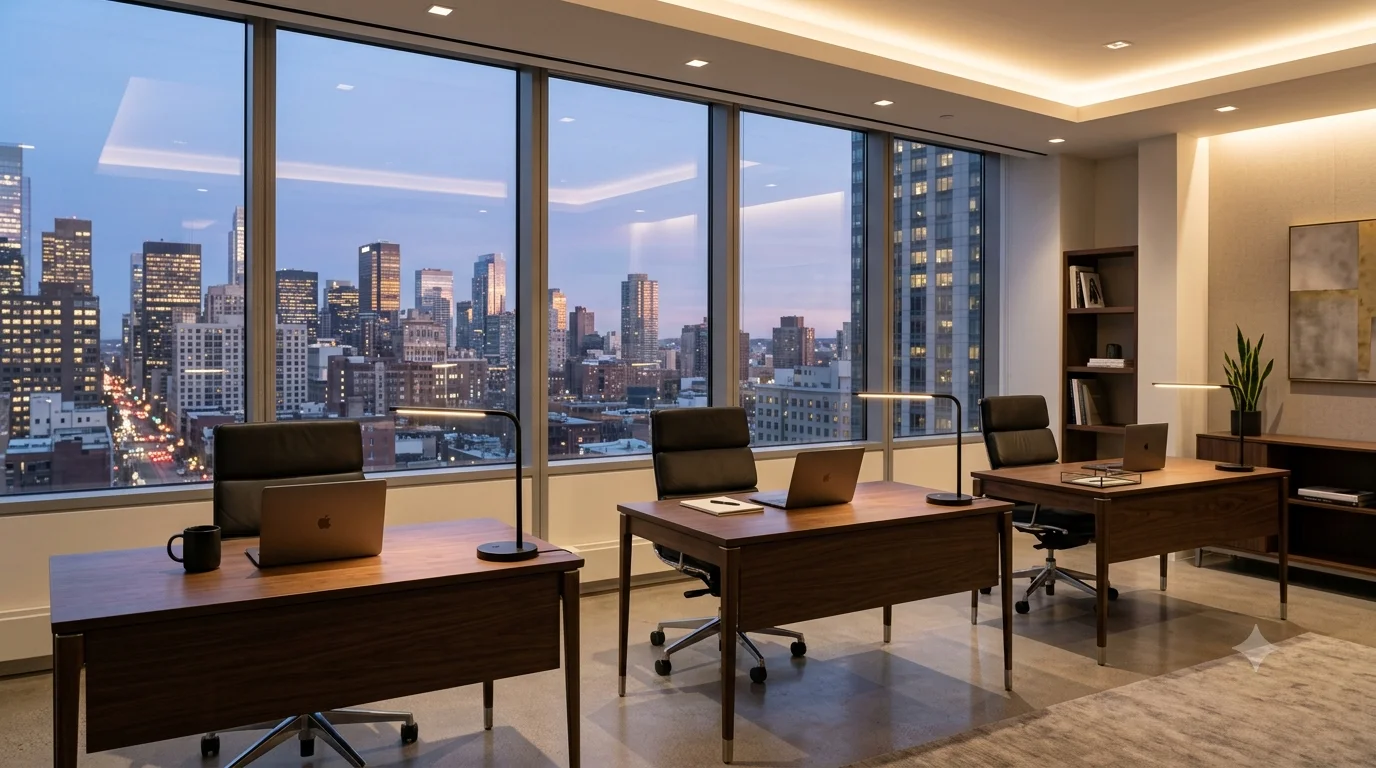
Your team walks in energized every morning, then quietly fades by early afternoon. Nobody blames the lighting, because nobody thinks to. Yet the fixtures overhead are working against your team’s focus every single day, in ways that are easy to miss and simple to fix.
This guide breaks down what actually matters, without drowning you in theory. If you want a professional to walk through your specific space, you can always book a consultation with The Shape Interiors and skip the guesswork entirely. Everything below is written to be practical enough to act on today.
Why Office Lighting Affects Productivity More Than You Think
Lighting does far more than help people see their screens. It quietly shapes alertness, mood, and energy across every hour of the workday. Your body reads light as a signal for when to feel sharp and when to slow down, and offices that ignore this signal fight against their own team without realizing it. A flat, unchanging light source, used the same way from morning to evening, sends the same message all day long, even as your team’s natural energy shifts underneath it. That mismatch builds up slowly, showing up as tiredness, short tempers, or a general sense that the afternoon just feels heavier than it should.
Most businesses spend generously on furniture, decor, and technology while treating lighting as an afterthought bolted on at the end. That is a costly mistake, because lighting touches every single task performed in the room, all day, every day. A slightly uncomfortable chair affects one person for part of the day. Poor lighting affects everyone in the room, for the entire time they are in it. Fixing it later, after furniture and finishes are already in place, is also almost always more disruptive and expensive than planning it correctly from the start.
The good news is that lighting is one of the most cost-effective upgrades available to any office. Small, targeted changes often produce results that are noticeable within days, not months. You do not need to gut the ceiling or replace every fixture to see a real difference in how your team feels by 4 p.m. The rest of this guide focuses on exactly where to start.
The Three Light Tones You Actually Need to Know
Color temperature is measured in Kelvin, and while the number sounds technical, the practical version is genuinely simple. Warm light, in the 2700K to 3000K range, has a soft, yellow-orange glow similar to early evening sunlight. It suits lounges, break rooms, and any corner meant for winding down rather than concentrating. Placed over an active desk, though, this same warmth tends to make people feel sluggish rather than sharp, which is exactly the opposite of what focused work needs.
Neutral light, sitting in the 3500K to 4100K range, is the safest default for most desks and shared work areas. It strikes a careful balance, staying clear and crisp without feeling cold or clinical. Because it works comfortably across long stretches of the day, many designers treat it as the standard choice for open-plan offices and general work areas. If you are ever unsure which tone to choose for a space, neutral is almost always the reliable answer, and it rarely creates the kind of complaints that warmer or cooler tones sometimes do.
Cool light, from 5000K to 6500K, carries a crisp, bluish tone that closely resembles daylight at its brightest. It genuinely sharpens focus and works well for detail-heavy tasks like drafting, technical review, or close inspection work. The catch is that this same energizing quality does not age well across a full room used all day. Spread everywhere in an office, cool light starts to feel harsh, and people often grow quietly tense without connecting the feeling back to the lighting above their heads.
The Fastest Fixes You Can Make This Month
Glare deserves to be fixed before anything else, because it is often the single biggest source of daily discomfort in an office. Turning desks away from direct window glare, or adding anti-glare filters to screens, usually costs very little and works almost immediately. People who squint or constantly reposition their monitors are spending real mental energy fighting their environment instead of focusing on their work. Multiplied across a full team, that quiet drain adds up to a real, if invisible, loss in output over the course of a week.
Task lighting is the next easiest win, and it is one of the cheapest upgrades available anywhere in an office. A simple, adjustable desk lamp gives each person control over their own comfort, which matters more than most people expect. Not everyone needs the same brightness to feel comfortable, and forcing one fixed ceiling setting on an entire room rarely satisfies everyone sitting underneath it. Letting individuals adjust their own lighting also removes a steady source of low-level irritation that people rarely bother mentioning out loud.
Layering ambient and task lighting together, rather than relying on one overhead source, rounds out the fastest set of fixes worth making. A single flat light source creates harsh shadows and an oddly tiring flatness, even when the overall brightness looks perfectly adequate on paper. Combining a softer ambient base with brighter task lighting exactly where it is needed breaks up that flatness immediately. These three fixes, done together, solve the majority of daily lighting complaints without requiring any structural changes to the room itself.
How to Light Different Zones of Your Office
Private offices and focus rooms benefit most from adjustable lighting that the occupant can control directly throughout the day. A dimmable overhead fixture paired with one desk lamp usually covers everything a single-occupant room needs, without requiring anything more complex. Being able to shift from a brighter, cooler tone in the morning to something softer later in the day supports the natural rhythm of focused work. Because only one person uses the space, this kind of flexibility is both simple to install and easy for that person to actually use consistently.
Open workstations need a different approach, since multiple people with different preferences share the same physical space. Even, glare-free ambient lighting matters more here than almost anywhere else in the building, precisely because no single ceiling setting will genuinely satisfy everyone. Adding individual task lighting at each desk respects the simple reality that ten people rarely agree on one ideal brightness level. Meeting rooms, meanwhile, benefit from lighting that can shift between presentation mode and open discussion mode, since harsh, uniform brightness tends to visibly tire people out during longer sessions.
Reception areas and entryways deserve particular attention, since this is often the very first impression a visitor forms of your business. A warm, welcoming tone at the entrance, transitioning gradually into the more neutral tones used deeper in the office, feels intentional rather than jarring. An abrupt shift from warm to cool light right at the door can make even a well-designed space feel disjointed the moment someone steps inside. Getting this single transition right shapes how the entire office is remembered, long after the visit itself is over.
When It’s Time to Call a Professional
Some lighting problems respond well to quick fixes, while others point to something more structural that keeps resurfacing no matter what you try. If people consistently avoid a specific desk, or one meeting room always feels more draining than the others, that pattern usually has a real, fixable cause behind it. A short walkthrough of the space at different times of day, morning, midday, and late afternoon, often reveals exactly where the problem is coming from. Recognizing these patterns early saves both time and money compared to repeatedly patching the same recurring issue.
AI design apps have genuinely improved and can be useful for early inspiration, quick mood boards, or a rough sense of style direction. What they cannot do is measure your actual daylight patterns, account for your building’s electrical layout, or physically walk your space at different hours. A generated image might look polished, but it cannot tell you whether afternoon glare near an east-facing window will make that desk unusable by 3 p.m. If you want to see how these decisions actually play out once installed, it is worth browsing The Shape Interiors’ completed projects for a clearer sense of what real, working lighting design looks like.
Independent freelancers and larger firms both have a place, depending on the size and complexity of the project in front of you. A freelancer can be a reasonable, affordable choice for a single small room, while a larger firm suits sprawling, multi-floor corporate rollouts with heavy logistics involved. For a boutique office or a growing small business, a mid-sized studio often strikes the most useful balance between personal attention and real technical depth. The right choice depends less on price alone and more on how complex your specific space actually is.
Putting It All Together
Office lighting rarely gets the attention it deserves, yet it shapes nearly every hour your team spends at work. Small, deliberate choices around color temperature, layering, and glare control add up to a space that quietly supports focus instead of working against it. None of this requires a dramatic renovation completed all at once. Phased, thoughtful changes, made gradually and with intention, deliver most of the comfort gains without the disruption of a full overhaul.
If you are ready to move past quick fixes and plan lighting that genuinely fits your team, your climate, and your specific space, get in touch with The Shape Interiors for a proper, considered plan. Strategy, after all, is what lasts long after any passing trend in style has faded.
Written by The Shape Interiors — Strategic Interior Design & 3D Visualization Studio, Karachi.